McKee Formula Calculator for Box Strength
Enter the box length and width, the board caliper and ECT to get the box compression strength, or enter a target strength to get the ECT you need.
The McKee formula calculator estimates how much compression load a corrugated box can carry. It uses the board’s edge crush test (ECT) value, the box length and width, and the board thickness. Enter the board’s ECT to get the box compression strength (BCT), or enter a target BCT to get the ECT the board needs. It can also estimate how many filled boxes can sit in one stack, with storage time, humidity and your own safety factor taken into account.
The tool is free, runs in your browser, and needs no sign-up. Use it as a corrugated ECT calculator when you are choosing board for a shipping box. The result is an estimate, so test real boxes before you rely on it.
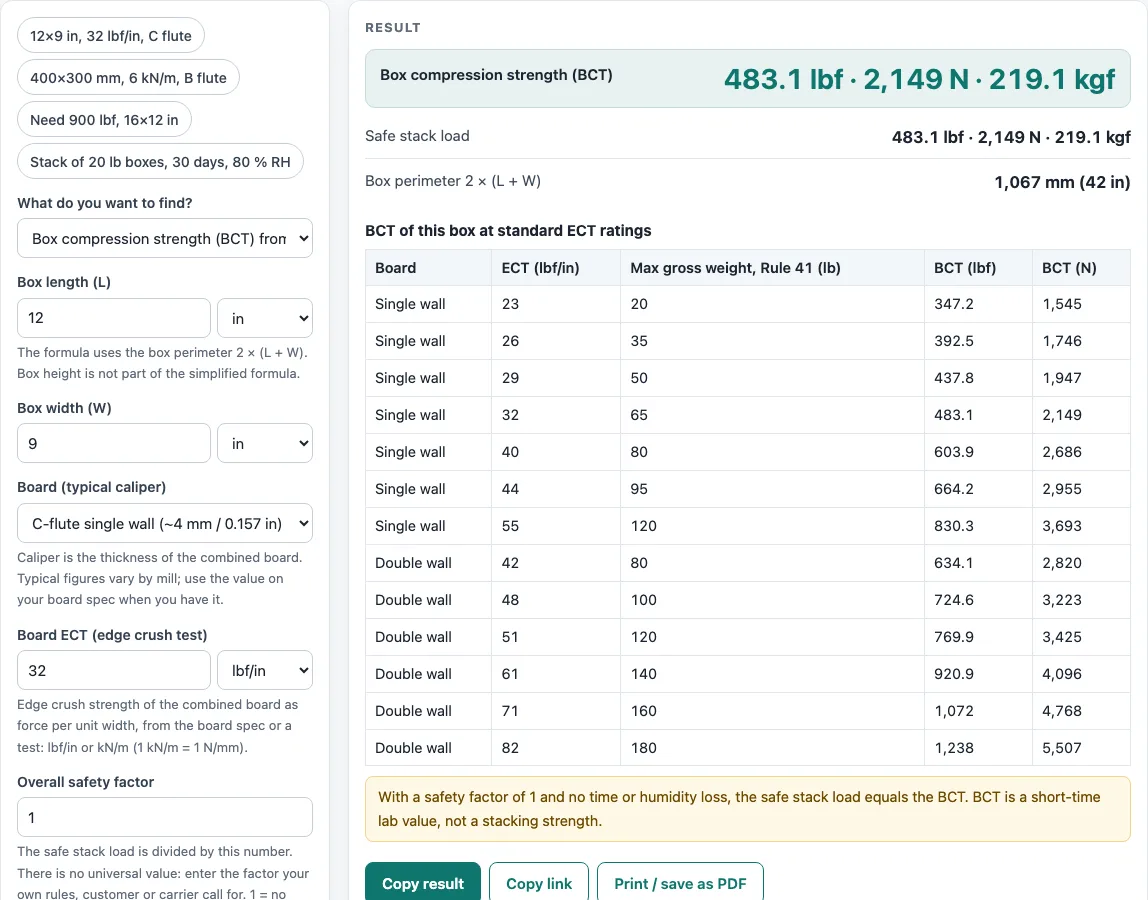
How to use the Box strength calculator
- Under “What do you want to find?”, choose “Box compression strength (BCT) from the board’s ECT” or “ECT needed for a target box compression strength”.
- Enter “Box length (L)” and “Box width (W)” in mm, cm or in.
- Pick a board from “Board (typical caliper)”: E-flute, B-flute or C-flute single wall, or BC double wall. For any other board, choose “Custom caliper” and enter the “Board caliper” in mm or in.
- Enter the strength value. In BCT mode, type the “Board ECT (edge crush test)” in lbf/in or kN/m. In ECT mode, type the “Target box compression strength (BCT)” in lbf, N or kgf.
- For stacking, enter “Weight of one filled box” in kg or lb. Leave it at 0 to skip the stack count.
- Enter “Overall safety factor” if you want a margin. The default of 1 means no margin.
- Under More options, set “Storage time under load” and the “Relative humidity under load” if the boxes will be stored under a load.
- Read the results: BCT, ECT needed, safe stack load, boxes per stack and box perimeter.
The four preset buttons fill in example inputs. “How it was calculated” shows each step with your numbers. “Copy link” keeps all your inputs, “Print / save as PDF” prints the inputs, results, steps and date, and “Reset” is also available.
What is the McKee formula?
The McKee formula is a simplified equation that predicts a corrugated box’s compression strength from the board’s ECT, the board caliper and the box perimeter. It is usually credited to McKee, Gander and Wachuta (Paperboard Packaging, 1963). We took that citation from secondary sources and did not read the original paper.
The formula is BCT = 5.87 × ECT × √(caliper × perimeter), where perimeter = 2 × (L + W). The constant works in any matching set of units. It is based on averages, so individual boxes vary above and below the result.
How do I calculate box compression strength from ECT?
Work out the perimeter, multiply it by the caliper, take the square root, then multiply by 5.87 and by the ECT. For a 12 × 9 in box with C-flute board (4 mm) and an ECT of 32 lbf/in, the perimeter is 42 in and the BCT is 483.1 lbf (2,149 N).
How do I find the ECT I need for a box that must hold a given load?
Rearrange the formula to ECT = BCT / (5.87 × √(caliper × perimeter)). Enter the BCT you need as the target. The tool uses it as it stands and does not add a safety factor or storage losses to it, so build any margin into the number.
For a 900 lbf target on a 16 × 12 in box with BC double-wall board, the ECT needed is 40.5 lbf/in (7.093 kN/m).
What is the difference between BCT and ECT?
ECT is the board’s edge crush test value. BCT is the compression strength of the finished box, which depends on the board and the box size.
How do humidity and storage time reduce box strength?
The tool multiplies BCT by a time multiplier and a humidity multiplier, then divides by the safety factor. The multipliers are general figures from a packaging supplier’s guide, not a guarantee for your board.
For a 16 × 12 in C-flute box with 44 lbf/in ECT, the BCT is 767 lbf. At 30 days, 80 % humidity and a safety factor of 2, the safe stack load is 156.5 lbf, which allows 8 boxes of 20 lb in a stack.
Sources
- McKee, Gander and Wachuta, “Compression strength formula for corrugated boxes”, Paperboard Packaging 48(8), 1963 — the original paper behind the formula; we did not read it, the formula and constants below come from the pages that quote it
- Westpak, McKee formula — BCT = 5.87 × ECT × √(caliper × perimeter), perimeter 2(L + W), inch units, and “BCT is not stacking strength”
- Archaviboonyobul et al., Agriculture and Natural Resources 59(2), 2025 — the same formula in metric units (constant 5.8745; kgf, kgf/cm, cm)
- ipack, How to guide: measuring boxes — the reverse form ECT = BCT ÷ [5.87 × √(caliper × perimeter)] and the published compression-loss multipliers for storage time and humidity
- ipack, Truck and rail rules — Rule 41 minimum ECT ratings by maximum gross weight
Worked examples
| Input | Result |
|---|---|
| Box 12 × 9 in, ECT 32 lbf/in | BCT 483.1 lbf · 2,149 N · 219.1 kgf |
| Box 400 × 300 mm, ECT 6 kN/m | BCT 513.1 lbf · 2,283 N · 232.8 kgf |
| Box 16 × 12 in, target BCT 900 lbf | ECT needed 40.5 lbf/in · 7.093 kN/m |
Calculated by the tool above with these values.
Frequently asked questions
How accurate is the McKee formula?
The formula is based on averages, so single boxes can be stronger or weaker than the result. It also leaves out box height, flaps, cut-outs, printing, pallet pattern and how the load is applied. Test real boxes with the reference compression test, ASTM D642, before you rely on the numbers.
Is the calculator free, and is anything I type uploaded?
Yes, the calculator is free and needs no sign-up. It runs in your browser, and nothing you type is uploaded.
What ECT rating do I need for a 50 lb box (Rule 41)?
The table “BCT of this box at standard ECT ratings” lists the Rule 41 minimum ECT ratings with their maximum gross weights (20 to 120 lb for single wall, 80 to 180 lb for double wall). In that table a 50 lb single wall box is rated at 29 lbf/in. The table values come from a packaging supplier’s summary of Rule 41, so check them against the current rule or your carrier’s requirements.
How many boxes can I stack on a pallet?
The tool gives boxes per stack, not a pallet plan. It divides the safe stack load by the weight of one filled box, rounds down and adds the bottom box, because the bottom box carries all the boxes above it. It does not include pallet-pattern factors, so the count applies to a single column of boxes.
How do I print or save my results?
Choose “Print / save as PDF” to print the inputs, results, steps and date. Choose “Copy link” to share a link that keeps all your inputs.
Related tools
- Cardboard box weight calculator: use it to estimate the weight of a box before you enter it as a stack load.
- Box size calculator: use it to find the outside dimensions you need before you enter length and width here.
- Double wall corrugated picker: use it to see which wall construction your box weight needs.
- Box template generator: use it to make a cutting pattern for a box you want to build.
- Mailer box sizes chart: use it to compare standard mailer box sizes.
- Rectangle box template: use it to print a flat template for a rectangular box.
- Poly mailer sizes chart: use it to compare standard poly mailer sizes.
- All calculators: use it to browse every calculator on this site.