Card Box Template
Choose a card size, enter how many cards are in the deck, and get a tuck box template with the inside size worked out for you.
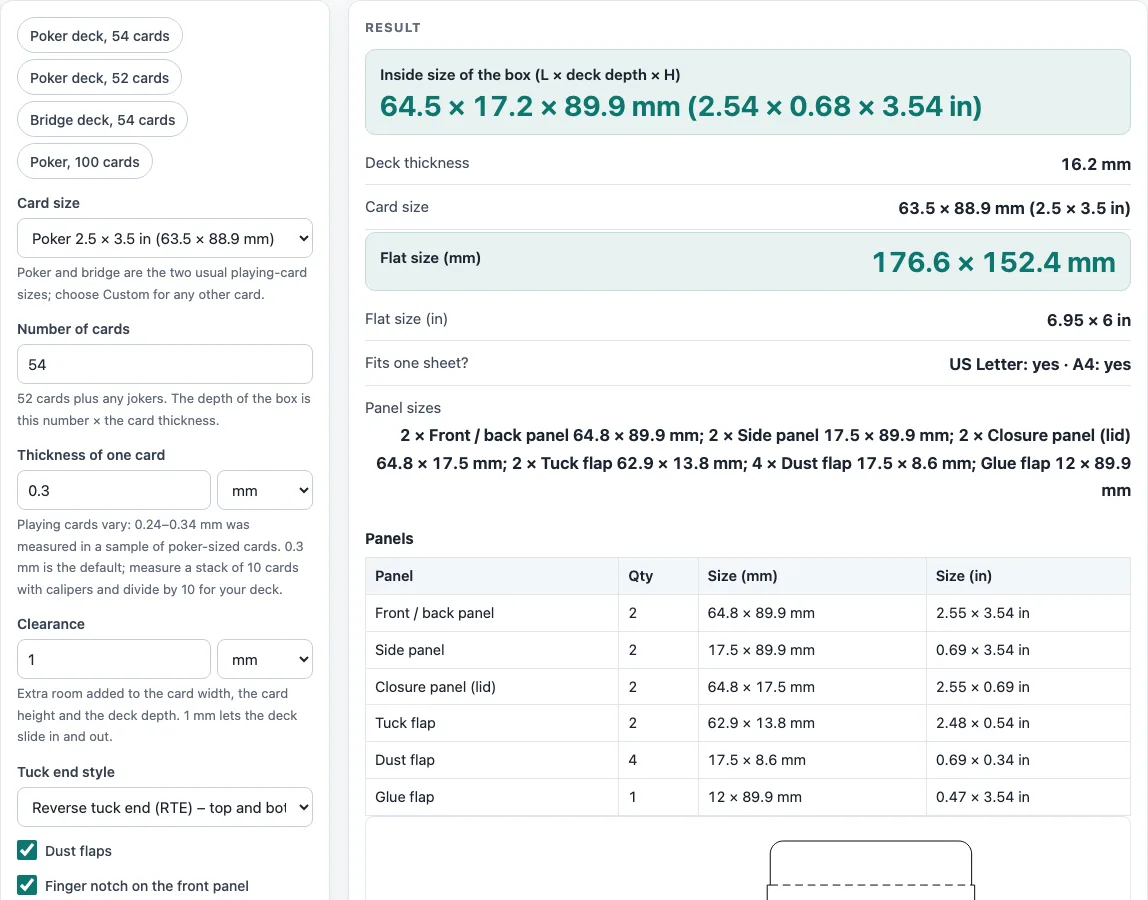
How to use the card box template
- Choose a ‘Card size’: Poker 2.5 × 3.5 in (63.5 × 88.9 mm), Bridge 2.25 × 3.5 in (57.15 × 88.9 mm) or Custom size. For Custom size, enter ‘Card width’ and ‘Card height’.
- Enter the ‘Number of cards’, a whole number from 1 to 500. The default is 54.
- Enter the ‘Thickness of one card’. The default is 0.3 mm. Measure a stack of 10 cards with calipers and divide by 10 for your deck.
- Set ‘Clearance’, the extra room added to the card width, card height and deck depth. The default is 1 mm.
- Pick a ‘Tuck end style’: reverse tuck end (RTE) or straight tuck end (STE).
- Tick or untick ‘Dust flaps’ and ‘Finger notch on the front panel’.
- Under ‘More options’, set the ‘Glue flap width’ (default 12 mm) and ‘Material thickness’ (default 0.3 mm).
- Read ‘Inside size of the box (L × deck depth × H)’, ‘Deck thickness’, ‘Card size’, ‘Flat size (mm)’, ‘Flat size (in)’, ‘Fits one sheet?’ and ‘Panel sizes’.
- Press ‘Download SVG (true size)’, ‘Download DXF (CAD / cutter)’ or ‘Print / save as PDF’, and print at 100%, not fit to page.
Example buttons such as ‘Poker deck, 54 cards’ fill in common decks. ‘Copy link’ keeps your inputs, ‘Copy result’ copies the figures and ‘How it was calculated’ shows each step.
What size is a poker card box template?
A poker card measures 2.5 × 3.5 in (63.5 × 88.9 mm), and a bridge card 2.25 × 3.5 in (57.15 × 88.9 mm). The inside of the box is the card size plus the clearance. With the default 1 mm clearance, a poker box is 64.5 mm wide and 89.9 mm tall inside. The depth is the deck thickness plus the clearance, so 54 cards at 0.3 mm give 17.2 mm.
How thick is a deck of 52 cards?
At 0.3 mm per card, a 52-card deck is 15.6 mm thick. Real cards vary: a sample of 67 poker-sized cards measured 0.24 to 0.34 mm each, which puts a 52-card deck between about 12.5 and 17.7 mm. Measure your own deck if the fit matters.
How much room should I leave around the cards?
The default clearance of 1 mm is added to the card width, the card height and the deck depth. Too little makes the cards hard to slide in, and too much lets the deck rattle.
How do I make a playing card box (tuck box) from a template?
Print the net at 100%, cut along the solid lines, fold along the dashed lines and glue the grey flap. The tuck flaps fold in at the top and bottom to hold the deck.
The geometry is the tool’s own design, not a standard. Flat width = glue flap + 2 × (L + t) + 2 × (W + t). Flat height = H + 2 × (W + t + tuck flap), where L, W and H are the inside length, depth and height, t is the material thickness, and the tuck flap is the smaller of 0.8 × W and H ÷ 2. The finger notch is a half circle with a radius of the smaller of 7 mm and (L + t) ÷ 5.
Sources
- Card sizes: poker 2.5 × 3.5 in (63.5 × 88.9 mm) and bridge 2.25 × 3.5 in (57.15 × 88.9 mm) — Wikipedia, Standard 52-card deck (poker-sized = the wide 3½ × 2½ in card, bridge-sized = the narrower card) and Mr. Playing Card, Playing Card Sizes (exact inch sizes)
- Card thickness: 0.24–0.34 mm in a sample of 67 poker-sized cards and 0.26–0.34 mm in 28 bridge-sized cards (Wikipedia, Standard 52-card deck); the 0.3 mm default is an input inside that range
- The net itself is the tuck box template geometry (plain geometry, own design parameters); FEFCO style codes are used only as names
- Paper sizes: A4 210 × 297 mm and A3 297 × 420 mm (ISO 216), US Letter 8.5 × 11 in and Tabloid 11 × 17 in (ANSI/ASME Y14.1)
- 1 in = 25.4 mm exactly (NIST SP 811)
Worked examples
| Input | Result |
|---|---|
| Poker 2.5 × 3.5 in (63.5 × 88.9 mm), 54 cards | Inside 64.5 × 17.2 × 89.9 mm (2.54 × 0.68 × 3.54 in); flat 176.6 × 152.4 mm; US Letter: yes · A4: yes |
| Bridge 2.25 × 3.5 in (57.15 × 88.9 mm), 52 cards | Inside 58.2 × 16.6 × 89.9 mm (2.29 × 0.65 × 3.54 in); flat 162.7 × 150.3 mm; US Letter: yes · A4: yes |
| Poker 2.5 × 3.5 in (63.5 × 88.9 mm), 100 cards | Inside 64.5 × 31.5 × 89.9 mm (2.54 × 1.24 × 3.54 in); flat 205.9 × 203.8 mm; US Letter: no · A4: no |
| Custom size, 60 cards | Inside 70.9 × 19 × 121.7 mm (2.79 × 0.75 × 4.79 in); flat 193 × 190.7 mm; US Letter: yes · A4: yes |
Calculated by the tool above with these values.
Frequently asked questions
What if my cards are not poker or bridge size?
Choose Custom size and enter the card width and height. Use it for tarot, flash cards, business cards or any other card; there is no tarot preset. Measure a card first, and measure the thickness of a stack to get the thickness of one card.
What is the difference between reverse and straight tuck end?
With a reverse tuck end (RTE) the top and bottom tucks sit on opposite sides of the box. With a straight tuck end (STE) both tucks sit on the same side.
Why does my template say it does not fit one sheet?
The tool checks the flat size against US Letter and A4 in either orientation, with a 1/4 in margin. If it fits neither, print it tiled across several sheets or on A3 or Tabloid, or send the SVG or DXF file to a plotter or cutter.
Can I use the card box template for commercial purposes or sell boxes on Etsy or Amazon KDP?
Yes. Templates you print or download may be used commercially, including for boxes sold on Etsy or Amazon KDP, royalty-free and with no attribution. The only limit is that you may not rebuild this generator as a competing service.
Is the calculator free, and is anything I type uploaded?
Yes, it is free, runs in your browser and needs no sign-up. Nothing you type is uploaded.
Related tools
- Tuck box template: use this for a general tuck box when your contents are not playing cards.
- Gift box template: use this when you want a box with a separate lid rather than a tuck closure.
- Box template generator: use this to design a box for items other than cards.
- Pillow box template: use this for a small pillow-shaped box for candy or favours.
- Matchbox template: use this for a sliding-drawer box in a matchbox style.
- Rectangle box template: use this for a plain rectangular box of set dimensions.
- Envelope template: use this to make an envelope to hold a card or letter.
- Label size chart: use this to check standard label sizes before printing labels for your box.