Cardboard Box Weight Calculator
Enter the box size (or a flat blank) and the board weight, or the liner and medium weights, to get the weight of one empty box and of a whole order.
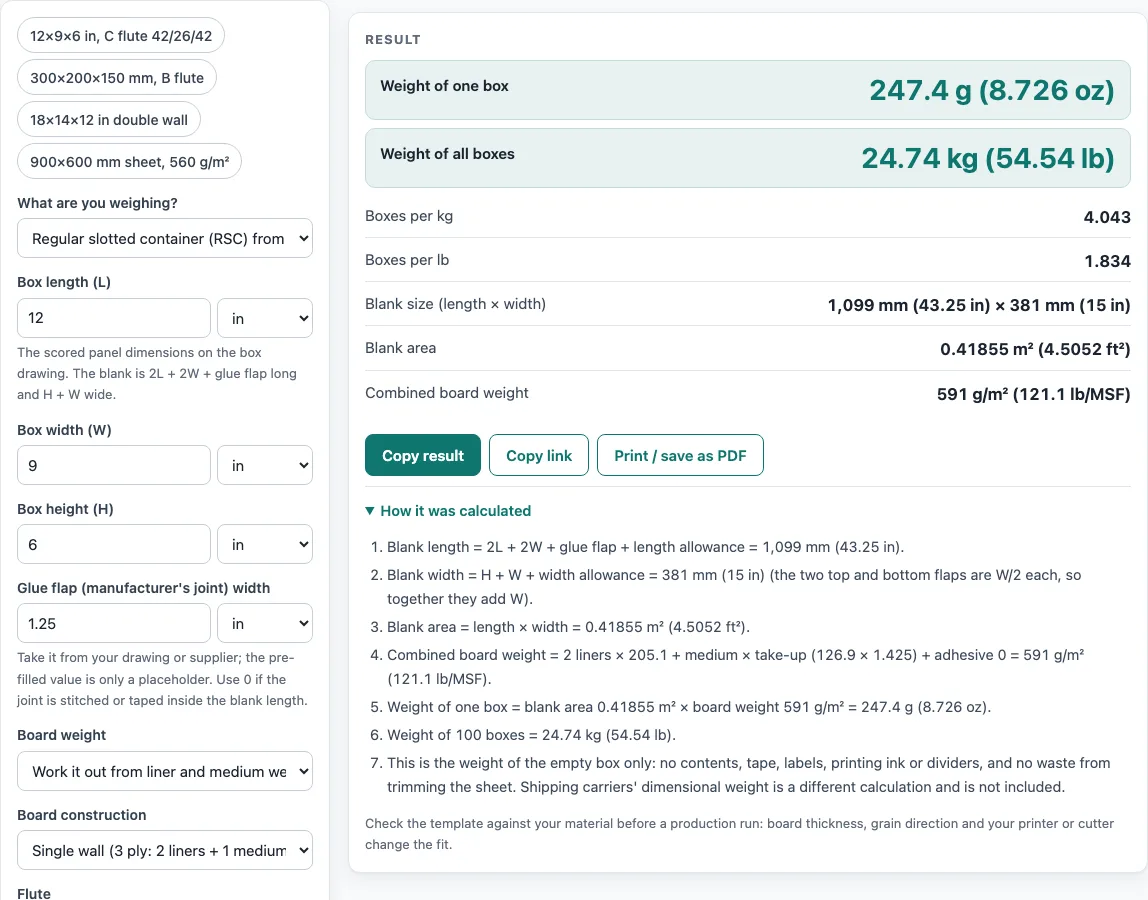
How to use the Carton weight calculator
- Under “What are you weighing?”, choose Regular slotted container (RSC) from L × W × H or Any flat blank (enter its length and width).
- For an RSC, enter Box length (L), Box width (W) and Box height (H) in mm or cm.
- Enter Glue flap (manufacturer’s joint) width. The pre-filled 1.25 in is only a placeholder, so replace it with your joint’s value. A value of 0 on an RSC gives a warning that the blank has no joint flap.
- For a flat blank, enter Blank length and Blank width instead.
- Under Board weight, pick either Work it out from liner and medium weights or I know the combined board weight.
- In build mode, choose the board construction, the flute or flutes, and enter the Liner weight (each liner) and Medium weight (each fluting). If you pick “Other”, enter your mill’s take-up factor. In known mode, enter the Combined board basis weight in g/m² or lb/MSF.
- Enter Number of boxes (a whole number from 1 to 1,000,000,000).
- Optionally, open More options for blank allowances or adhesive weight.
- Read the results and check any warning.
The preset buttons fill in worked examples. Copy link keeps your inputs in the address. Copy result, Print / save as PDF and Reset are also available, and How it was calculated shows each step with your numbers.
How much does an empty cardboard box weigh?
An empty box weighs its blank area multiplied by the combined board weight. The blank is the flat sheet of board before it is folded and glued.
For example, the 300 × 200 × 150 mm B flute preset has a blank of 0.36225 m² and a board weight of 439 g/m², so each box weighs 159 g.
How do I calculate the weight of a corrugated box?
Convert the blank to an area in m² and multiply by the combined board weight in g/m². In the same preset: 1,035 mm × 350 mm is 0.36225 m², and 0.36225 × 439 g/m² is about 159 g.
How do I find the blank size of a regular slotted container?
The blank length is 2L + 2W + the glue flap, and the blank width is H + W. The two top flaps are W/2 each, so together they add up to W. Any allowance is added on top.
For a 12 × 9 × 6 in box with a 1.25 in glue flap, the blank is 43.25 in long and 15 in wide. A 300 × 200 × 150 mm box with a 35 mm glue flap gives 1,035 × 350 mm.
What is a take-up factor and what is it for C flute or B flute?
The take-up factor is the length of medium needed per length of finished board. The tool uses 1.325 for B flute and 1.425 for C flute, the midpoints of the FEFCO ranges (1.30–1.35 and 1.40–1.45). Use “Other” if your mill gives its own number.
How do I work out combined board weight from liner and medium weights?
For single wall (3 ply), add two liners to the medium weight multiplied by the take-up factor. For double wall (5 ply), add three liners and two mediums, each medium with its own take-up factor; the same liner weight and the same medium weight are used throughout. Adhesive counts only if you enter it under More options.
Using the C flute preset: 42 + 26 × 1.44 + 42 = 121.4 lb/MSF. Since 1 lb/MSF = 4.882 g/m², this is about 592.9 g/m².
Sources
- FEFCO, Corrugated board production — take-up factor ranges (A 1.50–1.55, B 1.30–1.35, C 1.40–1.45, E 1.20–1.35) and the worked example that multiplies the fluting weight by the take-up factor
- US EPA, Sample calculation of postconsumer fiber content of a corrugated container — C flute take-up about 1.44 and the combined board weight sum in lb per 1,000 ft² (42 + 26 × 1.44 + 42 = 121.4)
- Blank length 2L + 2W + glue flap and width H + W for a regular slotted container: plane geometry from the folded panels; allowances are your own inputs
- 1 in = 25.4 mm and 1 lb = 453.59237 g exactly (NIST SP 811); 1 lb per 1,000 ft² = 4.8824 g/m²
Worked examples
| Input | Result |
|---|---|
| RSC 12 in × 9 in × 6 in, board 591 g/m² (121.1 lb/MSF) | 247.4 g (8.726 oz) per box |
| RSC 300 mm × 200 mm × 150 mm, board 439 g/m² (89.91 lb/MSF) | 159 g (5.61 oz) per box |
| Blank 900 mm × 600 mm, board 560 g/m² (114.7 lb/MSF) (entered) | 302.4 g (10.67 oz) per box |
Calculated by the tool above with these values.
Frequently asked questions
How much do 1,000 cartons weigh?
Multiply the weight of one box by 1,000. The 300 × 200 × 150 mm B flute preset weighs 159 g per box, so 1,000 boxes weigh 159 kg. Enter 1,000 in Number of boxes to get the total for your own size.
How many boxes are there in a kilogram or pound?
Boxes per kg is 1 divided by the weight of one box in kg. Boxes per lb is 1 divided by the weight in lb. For the 12 × 9 × 6 in preset, one box weighs 8.754 oz (0.547 lb), which gives about 1.828 boxes per lb.
How much does a 3 ply or 5 ply carton weigh?
A 3 ply (single wall) box has 2 liners and 1 medium. A 5 ply (double wall) box has 3 liners and 2 mediums, so it is heavier for the same size. The 18 × 14 × 12 in double wall preset, with B and C flutes, weighs 1.059 kg (2.336 lb) per box. Enter your own size and board to get a figure for your carton.
Does the result include tape, labels or carrier dimensional weight?
No. The result is the weight of the empty box only. It excludes contents, tape, labels, ink, dividers, trimming waste, and carrier dimensional weight, which is a separate calculation. Real board weight varies with the mill and with moisture, so check the result against your supplier’s spec or a weighed sample.
Is the calculator free, and is anything I type uploaded?
Yes, it is free and needs no sign-up. It runs in your browser, and nothing you type is uploaded.
Related tools
- Box size calculator: use it to work out the box dimensions you need before you weigh them here.
- Corrugated flute sizes chart: use it to look up flute thickness and flutes per foot.
- McKee formula calculator: use it to estimate how much compression a box can take.
- Box template generator: use it to create a printable template for a box.
- Mailer box sizes chart: use it to compare standard mailer box sizes.
- Rectangle box template: use it when you need a flat template for a rectangular box.
- Pizza box dieline: use it to get the layout for a pizza box.
- Poly mailer sizes chart: use it to compare standard poly mailer sizes.
- All calculators: use it to browse every calculator on this site.