Corrugated Flute Sizes Chart
Look up any flute, or count the flutes on a piece of board to find out which flute size it is.
Corrugated flute sizes are the standard wave sizes of the fluted layer inside cardboard: A, B, C, E and F flute, plus double wall combinations such as EB and BC. This corrugated flute sizes chart gives the thickness in millimetres and inches and the number of flutes per foot and per metre for each one. It also works as an identifier: count the flutes along a cut edge, type the number in, and it names the closest flute.
The tool is free, runs in your browser and nothing you type is uploaded. The chart is always shown below the result, so you can read every flute at once.
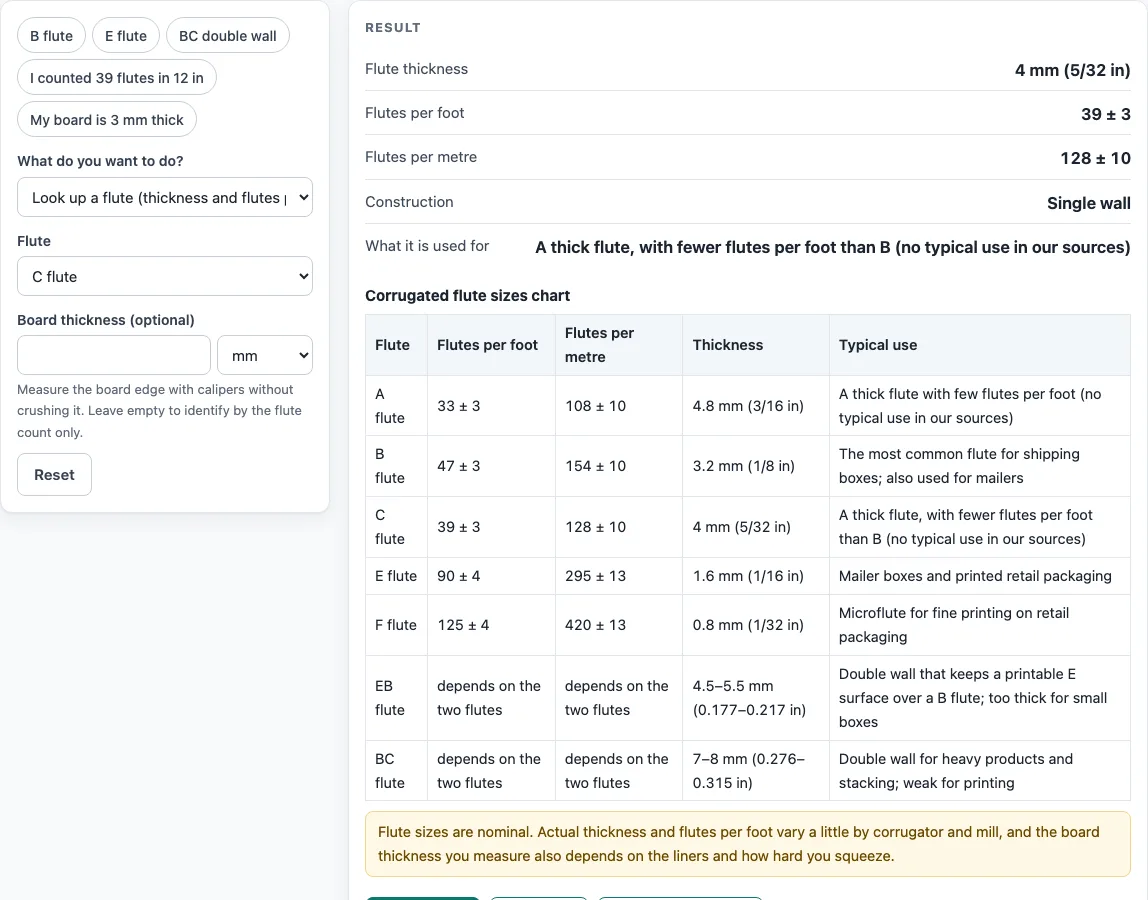
How to use the corrugated flute sizes chart
- Under What do you want to do?, choose “Look up a flute (thickness and flutes per foot)” or “Identify a flute from my board”.
- To look up a flute, open Flute and pick A, B, C, E, F, EB or BC. The results show the thickness, flutes per foot and per metre, the construction and what it is used for.
- To identify your board, cut a clean edge and count the flutes (the waves) along a straight line. Type the number in Flutes counted and the length you counted over in Length counted over, in inches or centimetres. The default is 12 in, one foot.
- Optionally enter Board thickness in mm or in, measured with calipers without crushing the board. You can use the thickness alone, but the count is more reliable.
- Read the Best match and the flutes per foot you counted. A warning appears if the count and the thickness point to different flutes, or if the count fits none of the five single wall flutes.
- Check How it was calculated, then read the chart table below.
Presets such as “B flute”, “BC double wall”, “I counted 39 flutes in 12 in” and “My board is 3 mm thick” fill the form. Copy link shares your inputs, Print / save as PDF prints the result with the date, and Reset clears it.
What are the standard corrugated flute sizes?
The five common single wall flutes are A, B, C, E and F. A flute has 33 ± 3 flutes per foot and is 3/16 in (4.8 mm) thick. B flute has 47 ± 3 and is 1/8 in (3.2 mm). C flute has 39 ± 3 and is 5/32 in (4.0 mm). E flute has 90 ± 4 and is 1/16 in (1.6 mm). F flute, also called microflute, has 125 ± 4 and is 1/32 in (0.8 mm). Per metre the counts are about 108, 154, 128, 295 and 420.
The letters follow the order in which the flutes were invented, not their size, so C is thicker than B and E is thinner than both.
How do you identify a flute size?
Count the flutes per linear foot. Wikipedia says this is a more reliable way to identify a flute than thickness, because actual dimensions vary slightly by corrugator. A count of 39 in 12 inches is C flute, 47 is B flute and 90 is E flute. The tool also converts a count over another length: 154 flutes in 1 metre is 46.9 per foot, which is B flute.
Counts close to a boundary can fit two flutes. For example, 36 per foot is within the tolerance of both A flute (33 ± 3) and C flute (39 ± 3). The tool lists every flute whose tolerance fits and names the closest, so count again over a longer length to be sure.
How thick is each flute?
A flute is the thickest of the five at 4.8 mm, then C at 4.0 mm, B at 3.2 mm, E at 1.6 mm and F at 0.8 mm. Thickness figures differ a little between suppliers. Sourceful gives 2.5 to 3.5 mm for B flute and 1.5 to 2.0 mm for E, which brackets the chart values. The box size calculator on this site uses typical figures of 3 mm for B and 4 mm for C.
How thick is double wall board?
Double wall board stacks two flute layers, so it is thicker, but not simply the sum of the two flutes. Sourceful gives 4.5 to 5.5 mm for EB flute and 7.0 to 8.0 mm for BC flute. Another supplier summary used on this site gives about 6.1 to 6.7 mm for BC, so double wall figures vary by mill. Measure your own board when it matters. See the double wall corrugated picker to check which wall you need for your box weight.
Which flute is best for mailers and shipping boxes?
Sourceful says E flute is common for mailer boxes and good for printing, and B flute is the most common profile for shipping boxes. Packlane gives B flute (1/8 in) as the default for shipping boxes and E flute (1/16 in) for small and medium mailers. Wikipedia notes that finer flutes such as E and F give smoother printing surfaces and are used for retail packaging and mailer boxes. For heavy items, Sourceful points to double wall such as BC.
Sources
Figures used by this tool (checked October 2026):
- Corrugated fiberboard, Wikipedia — flute table (A, B, C, E, F: flutes per foot and per metre, thickness in inches and mm) and the advice to count flutes per foot
- Packlane, how thick is the material of my boxes — B flute 1/8 in and E flute 1/16 in
- Sourceful, Fluting — thickness ranges for E, B, EB and BC flute and what each is used for
Worked examples
| Input | Result |
|---|---|
| B flute | 3.2 mm (1/8 in); 47 ± 3 flutes per foot |
| 47 flutes in 12 in | B flute: 47 ± 3 flutes per foot, 3.2 mm (1/8 in) thick |
| 1.6 mm | E flute: 1.6 mm (1/16 in) thick (by thickness only; the flute count is more reliable) |
Calculated by the tool above with these values.
Frequently asked questions
How many flutes per foot is C flute?
C flute has 39 ± 3 flutes per foot, which is about 128 per metre, and it is 5/32 in (4.0 mm) thick.
Which is thicker, B flute or C flute?
C flute is thicker. It is 4.0 mm (5/32 in) against 3.2 mm (1/8 in) for B flute, but it has fewer flutes per foot: 39 against 47.
What is the thinnest flute?
F flute, also called microflute, at 1/32 in (0.8 mm) with 125 ± 4 flutes per foot. E flute follows at 1/16 in (1.6 mm).
What flute is a standard shipping box?
The shipping box flute named by both Sourceful and Packlane is B flute. Other flutes, such as C and double wall, are also used, so check your supplier’s specification.
Does the letter mean the size?
No. The letters A, B, C, E and F follow the order in which the flutes were invented. Size is given by the thickness and the number of flutes per foot.
Why does my measured thickness not match the chart?
The chart lists nominal values. The thickness you measure depends on the liners, the corrugator and how hard you squeeze the board. Count flutes per foot instead; it is the more reliable method.
Is the chart free, and is anything I type uploaded?
Yes, it is free and needs no sign-up. It runs in your browser, and nothing you type is uploaded.
Can I use the chart in commercial work such as quotes and specifications?
Yes. You may use the results in commercial work, including specifications and quotes sent to box makers, without attribution. Flute dimensions vary slightly by mill, so confirm the board with your supplier before an order.
Related tools
- Box size calculator: use it to find inside and outside box dimensions with board thickness.
- McKee formula calculator: use it to estimate box compression strength from the board caliper.
- Double wall corrugated picker: use it to see when single, double or triple wall is needed.
- Cardboard box weight calculator: use it to weigh an empty corrugated box.
- Box template generator: use it to make a dieline for a box.
- All tools: use it to browse every tool on this site.