Double Wall Corrugated: Which Wall Do You Need?
Enter the weight of the packed box to see which wall construction covers it and the minimum ECT and burst rating to ask for.
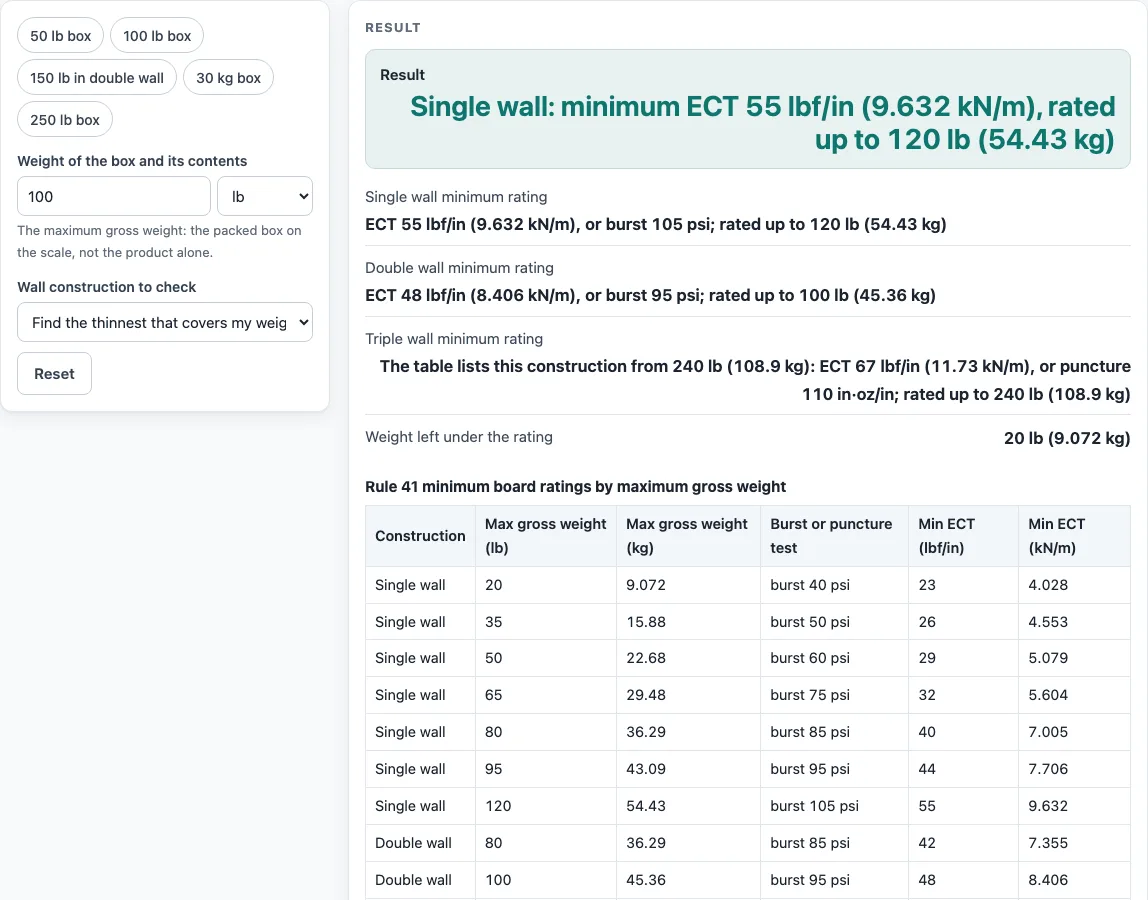
Double wall corrugated is cardboard made of two layers of fluting between three flat liners, used when a single wall box is not strong enough. This double wall corrugated picker takes the weight of your packed box and shows which wall construction, single, double or triple, has a rating that covers it. For each one it gives the minimum edge crush test (ECT) value and the burst or puncture test value from the carrier box rules (Rule 41).
Use it to decide when to move from single to double wall, or to write the board specification you ask a box maker for. The tool is free, runs in your browser and nothing you type is uploaded. It lists the whole rating table too.
How to use the double wall corrugated picker
- Enter Weight of the box and its contents and pick lb or kg. Use the packed box on the scale, not the product alone, because the rules rate the maximum gross weight.
- Leave Wall construction to check on “Find the thinnest that covers my weight” to let the tool choose, or pick “Single wall”, “Double wall” or “Triple wall” to check one of them.
- Read the Result. It names the construction and the minimum ECT, in lbf/in and kN/m, and the weight the rating goes up to.
- Compare the lines for Single wall minimum rating, Double wall minimum rating and Triple wall minimum rating. A line that says “Not enough” means that construction tops out below your weight.
- Check Weight left under the rating. It shows how far below the rating your box is.
- Open How it was calculated to see which table row each answer came from.
- Scroll to the full table of ratings for all 17 rows.
Choose a preset such as “50 lb box”, “100 lb box” or “250 lb box” to see how the answer changes. Copy link shares your inputs, Print / save as PDF prints the result with the date, and Reset restores the defaults.
What is double wall corrugated?
Double wall corrugated board is made of three flat linerboards with two fluted layers between them. A single wall board has two liners and one fluted layer. The extra layer makes the board thicker and stiffer, so it carries more weight and resists puncture and stacking loads better. Wikipedia notes that double and triple wall board are made for high stacking strength and puncture resistance. Common double wall combinations are BC and EB flute.
When do I need double wall instead of single wall?
Use the weight of the packed box. In the Rule 41 table the single wall ratings stop at 120 lb, and double wall ratings run from 80 lb to 180 lb. A 100 lb box can be single or double wall: single wall needs ECT 55 lbf/in (the 120 lb row), while double wall needs only ECT 48 lbf/in (the 100 lb row). A 150 lb box needs double wall at ECT 71 lbf/in, the 160 lb row. Between 180 and 240 lb the table has no row, and triple wall starts at 240 lb.
How much heavier can a double wall box be?
The ratings jump with each step. Single wall boxes are rated from 20 to 120 lb, double wall from 80 to 180 lb, and triple wall from 240 to 300 lb. The minimum ECT rises with the weight: 23 lbf/in at 20 lb single wall, 42 lbf/in at 80 lb double wall and 67 lbf/in at 240 lb triple wall. There is no table row for triple wall below 240 lb, so the tool says so.
Is double wall stronger in stacking?
Usually, because the board is thicker. In the McKee formula, box compression strength grows with the square root of the board caliper. For a 16 × 12 in box with an ECT of 44 lbf/in, a 4 mm board gives 767 lbf and a 6.5 mm board gives 978 lbf, about 27 % more. In practice double wall also has a higher ECT than single wall, so the gain is larger. Use the McKee formula calculator to work out your own box.
What are burst and ECT ratings?
Rule 41 lets a box maker meet either a burst test (pounds per square inch, with a minimum combined basis weight) or an edge crush test (pounds per inch of width). Triple wall uses a puncture test instead of burst. The tool shows the burst or puncture value and the ECT value for each row. Ask the maker for either one, and for the box manufacturer’s certificate printed on the box.
Does this tool say my box passes Rule 41?
No. The full rule also limits the outside size of the box, length plus width plus depth, for each rating. The summary used here does not list that column, so the tool shows the weight rating only. Check the full rule or your carrier before you rely on a rating.
Sources
Ratings and facts used by this tool (checked October 2026):
- ipack, Truck and rail rules — Rule 41 and NMFC Item 222 minimum burst, puncture and ECT ratings by maximum gross weight for single, double and triple wall boxes, and the box manufacturer’s certificate
- Corrugated fiberboard, Wikipedia — single wall, double wall and triple wall construction, and that double and triple wall board is made for stacking strength and puncture resistance
- Sourceful, Fluting — EB and BC flutes as double wall combinations; BC for heavy products and stacking
- McKee, Gander and Wachuta (1963), through Westpak — compression strength grows with the square root of caliper times perimeter
Worked examples
| Input | Result |
|---|---|
| 50 lb, best fit | Single wall: minimum ECT 29 lbf/in (5.079 kN/m), rated up to 50 lb (22.68 kg) |
| 100 lb, best fit | Single wall: minimum ECT 55 lbf/in (9.632 kN/m), rated up to 120 lb (54.43 kg) |
| 150 lb, Double wall | Double wall: minimum ECT 71 lbf/in (12.43 kN/m), rated up to 160 lb (72.57 kg) |
Calculated by the tool above with these values.
Frequently asked questions
What does double wall corrugated mean?
It means a corrugated board with two fluted layers and three liners. The layers can be the same flute or two different ones, for example B and C flute, written BC. It is thicker and stronger than single wall.
Is double wall stronger than single wall?
Yes, for the same box size. The Rule 41 table lists higher weight ratings for double wall: 80 to 180 lb against 20 to 120 lb for single wall. A box maker can still build a strong single wall box, so look at the ECT or burst value, not only the wall count.
What is triple wall corrugated?
Triple wall has three fluted layers and four liners. In the Rule 41 table it covers 240 to 300 lb, with a puncture test of 110 to 125 in·oz per inch of tear and an ECT of 67 to 112 lbf/in. Heavier loads than 300 lb need another kind of package.
What does BC flute mean in a double wall box?
BC is a double wall board that combines B flute and C flute layers. Sourceful describes it as one of the most durable profiles, suited to heavy products and stacking, but not as good for printing as EB. EB flute pairs E and B layers for better print quality.
What ECT do I need for a double wall box?
It depends on the weight. For double wall the Rule 41 minimums are 42 lbf/in at up to 80 lb, 48 at 100 lb, 51 at 120 lb, 61 at 140 lb, 71 at 160 lb and 82 at 180 lb. Enter your weight and the tool picks the row.
Can I use the picker for shipping to any carrier?
It uses the Rule 41 weight table, which comes from US freight carrier rules. Parcel carriers and other countries can ask for something different, and the box size also counts. Always check your carrier’s own packaging rules.
Is the picker free, and is anything I type uploaded?
Yes, it is free and needs no sign-up. It runs in your browser, and nothing you type is uploaded.
Can I use the result in commercial work such as quotes and specifications?
Yes. You may use the results in commercial work, including specifications and quotes sent to box makers, without attribution. The table values come from a packaging supplier’s summary of Rule 41, so check them against the current rule before a production order.
Related tools
- McKee formula calculator: use it to estimate how much stacking load a box can take.
- Cardboard box weight calculator: use it to weigh the empty box before you add the contents.
- Corrugated flute sizes chart: use it to look up flute thickness and flutes per foot.
- Box size calculator: use it to find the box size you need.
- Mailer box sizes chart: use it to compare standard mailer box sizes.
- All tools: use it to browse every tool on this site.