Envelope Size Chart and Finder
Look up envelope sizes in inches and mm, or pick a paper size and fold to see which envelopes fit.
This free envelope size chart tool shows which envelope fits your paper, flat or folded, and gives the result in inches and millimeters. Pick a paper size and a fold, and it lists the smallest envelope that fits, along with every other size on the chart that works. A total of 25 sizes sits on the chart: the ISO 269 C, B and DL sizes and the common US commercial, announcement and catalog sizes. Everything runs in your browser, needs no sign-up, and nothing you type is uploaded.
Read it as an envelope measurement chart: every size is the outside width × height. Check mailer envelope sizes, card and invitation envelopes, or business envelopes for a print job with it. Below, the guide covers the sizes people ask about most, including the US #10 and the ISO sizes that hold A4 paper.
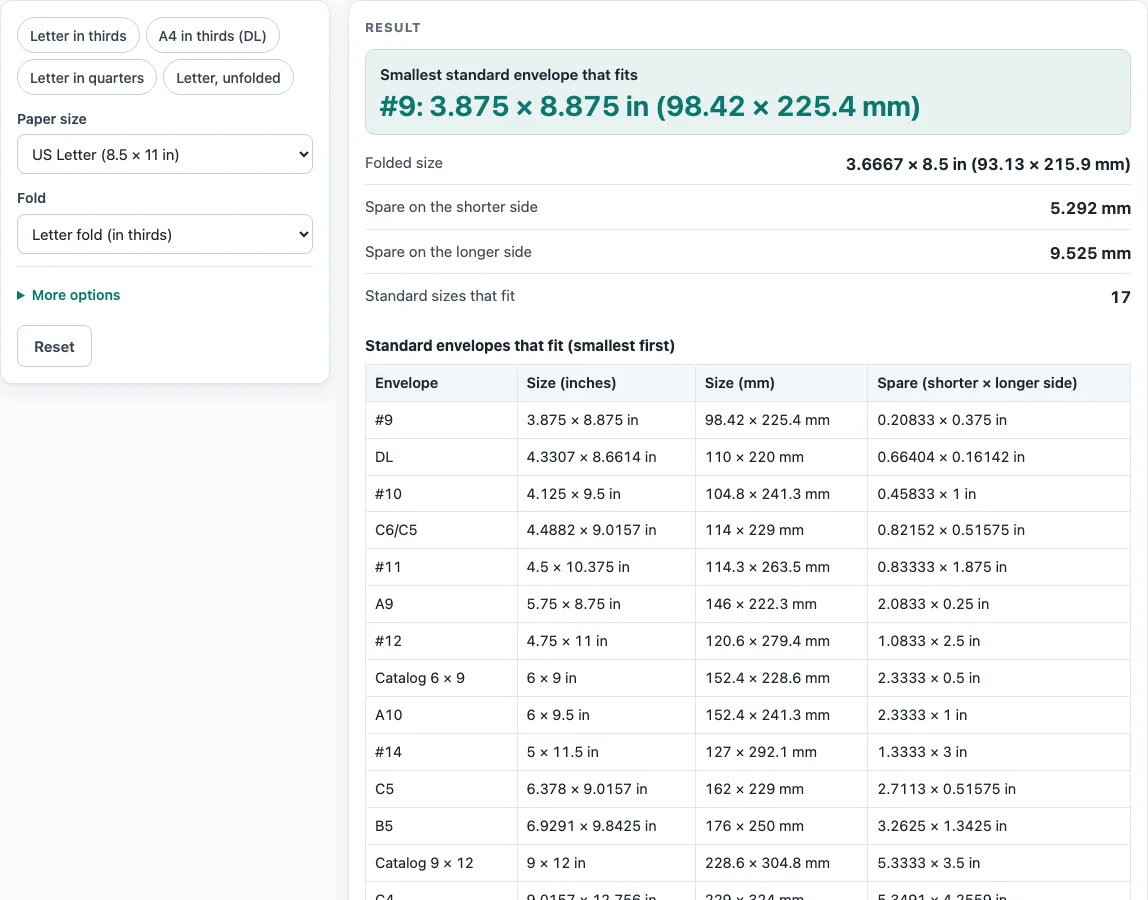
How to use the Envelope size calculator
- Open Paper size and pick US Letter, A4, A5, Half Letter or Custom size. With a custom size, type the sheet into Paper width and Paper height, selecting inches, mm or cm for each.
- Next, open Fold and select No fold (flat), In half, Letter fold (in thirds) or In quarters (half, then half again).
- Need extra room? Open More options and adjust Minimum clearance. It defaults to 1/8 in (3 mm).
- Check the results. Smallest standard envelope that fits gives the best size. Folded size shows the paper once folded. Spare on the shorter side and Spare on the longer side list the room left over. Standard sizes that fit tallies every match.
- Heed any warning before going further. If the folded paper exceeds every size on the chart, fold it smaller or use a custom envelope.
- Scroll down to the tables. The first lists the envelopes that fit, smallest first. A second shows the full chart with a “Fits your folded paper?” column. A third gives a typical #10 window position.
Above the form, the example buttons fill in Letter in thirds, A4 in thirds (DL), Letter in quarters and Letter, unfolded, so you can see a finished result first. Copy result copies the result lines. Copy link copies a page address that holds every input. Print / save as PDF sends the result to print. Reset restores the default values, and How it was calculated shows each step using your own numbers.
What size envelope fits a letter folded in thirds?
A US Letter sheet folded in thirds measures about 3.67 × 8.5 in. The envelope must be at least that size plus the clearance, so with the default 0.125 in clearance the tool’s example needs at least 3.7917 × 8.625 in. The #9 envelope, at 3.875 × 8.875 in, is the smallest size by area that fits, with 0.20833 in spare on the shorter side and 0.375 in on the longer side. In total, 17 sizes on the chart fit.
The sheet can go into the envelope either way round, so the tool compares the short side with the short side and the long side with the long side. The sizes in the chart are outside sizes, and the minimum clearance is extra room wanted in both directions.
Envelope size guide: what size is a #10 envelope?
The US #10 envelope measures 4⅛ × 9½ in (4.125 × 9.5 in). It is the most common business envelope for Letter paper folded in thirds. The tool may warn that a smaller size, such as the #9, also fits. In that case, choose the size your printer, inserter or post office expects.
The other US commercial sizes on the chart are the #6¾ (3⅝ × 6½ in), #7 (3¾ × 6¾ in), #9, #11 (4½ × 10⅜ in), #12 (4¾ × 11 in) and #14 (5 × 11½ in). The announcement sizes, used for cards and invitations, are the A2 (4⅜ × 5¾ in), A6 (4¾ × 6½ in), A7 (5¼ × 7¼ in), A8 (5½ × 8⅛ in), A9 (5¾ × 8¾ in) and A10 (6 × 9½ in). An A7 envelope fits a 5 × 7 in card. The catalog sizes, often used for booklets and flat mail, are 6 × 9, 9 × 12 and 10 × 13 in. These US sizes are common sizes, not a formal standard.
What are the ISO envelope sizes?
The ISO 269 sizes are a formal standard, and the chart lists them in millimeters and inches. A C4 envelope, 229 × 324 mm, holds A4 paper unfolded. A C5 envelope, 162 × 229 mm, holds A4 folded once to A5. A DL envelope, 110 × 220 mm, holds A4 folded in thirds. The C6 is 114 × 162 mm, the C6/C5 is 114 × 229 mm, and the C3 is 324 × 458 mm. The B sizes are B4 at 250 × 353 mm, B5 at 176 × 250 mm and B6 at 125 × 176 mm.
What size is a window envelope?
The tool shows a typical #10 window position: 7/8 in (22.22 mm) from the left edge, 1/2 in (12.7 mm) from the bottom edge, and 4½ × 1⅛ in (114.3 × 28.57 mm) in size. This layout is widely used but varies by maker, so check with your printer. The tool does not list window positions for other envelope sizes.
Sources
- papersizes.org, US & North American envelope sizes — #6¾ to #14, A2 to A10, catalog sizes
- ISO 269 envelope sizes (C3–C6, DL, B4–B6), as derived from ISO 216 paper sizes
- #10 window 4½ × 1⅛ in, 7/8 in from the left and 1/2 in from the bottom (standard single-window spec, e.g. Filing.com Digi-Clear Window C)
- 1 in = 25.4 mm exactly (NIST SP 811)
Worked examples
| Input | Result |
|---|---|
| US Letter (8.5 × 11 in), Letter fold (in thirds) | #9: 3.875 × 8.875 in (98.42 × 225.4 mm) |
| A4 (210 × 297 mm), In half | Catalog 6 × 9: 6 × 9 in (152.4 × 228.6 mm) |
| US Letter (8.5 × 11 in), In quarters (half, then half again) | A2: 4.375 × 5.75 in (111.1 × 146 mm) |
| Half Letter (5.5 × 8.5 in), No fold (flat) | A9: 5.75 × 8.75 in (146 × 222.3 mm) |
| 100 × 150 mm, No fold (flat) | C6: 4.4882 × 6.378 in (114 × 162 mm) |
Calculated by the tool above with these values.
Frequently asked questions
Is the calculator free, and is anything I type uploaded?
Yes, the tool is free, runs entirely in your browser, and needs no sign-up. Nothing you type is uploaded.
Can I use the results in commercial work?
Yes. Results may be used in commercial work, including quotes, and no attribution is needed. Check any terms your client sets.
What does Minimum clearance do?
It sets the extra room wanted in both directions, and the default is 1/8 in (3 mm). Raise it when your contents need more room than the default.
Why does the tool warn that my custom size is under 50 mm?
The tool shows this warning when one side of a custom paper size is under 50 mm (2 in). Check the units on the field, because the same number means very different sizes in inches and millimeters.
Why does the tool say the folded paper needs a bigger envelope?
The folded paper is larger than every size on the chart. Fold it smaller, or use a custom envelope.
Are the envelope sizes outside or inside sizes?
They are outside sizes. The usable inside is slightly smaller, which the minimum clearance is there to cover.
Does the tool list every envelope type?
No. It lists the 25 sizes on the chart: the ISO 269 C, B and DL sizes and the common US commercial, announcement and catalog sizes. It does not list padded mailers or other special types.
Related tools
- Box size calculator: Helpful when your contents are too thick or stiff for an envelope and need a box.
- Mailer box sizes chart: Look over common mailer box dimensions if you ship something bigger than an envelope.
- Poly mailer sizes chart: Scan common poly mailer sizes for soft, flat items.
- Label size chart: Pick the label dimensions that suit an envelope or package you plan to print on.
- Box template generator: A folding box template built from dimensions you enter yourself.
- Pizza box dieline: Dieline for a pizza box, handy while you work on packaging design.
- Tuck box template: Tuck-top box template sized for small products.
- Envelope template: Print and fold your own envelope for any card size with this template.
- All calculators: Every calculator on the site, all in one list.