Gift Box Template (Box with Lid)
Type the inside size of the box and get a base and a matching lid that slides over it, ready to print.
This gift box template tool creates a printable template for a box with a lid: a base tray and a lid tray, both drawn on one sheet. Enter the inside length, width and height of the base, and it draws the cut, fold and glue lines at real size, with sizes in millimeters and inches. It is free, runs in your browser, needs no sign-up, and uploads nothing you type.
Download the template as an SVG or DXF file for design software and cutting machines, or save it as a PDF to print. Use it when you need a box that fits a specific item, whether for one present or a small batch. It draws a rectangular box and lid only, not a heart or exploding box. Test a sample on your own material before cutting a larger run.
How to use the Gift Box Template
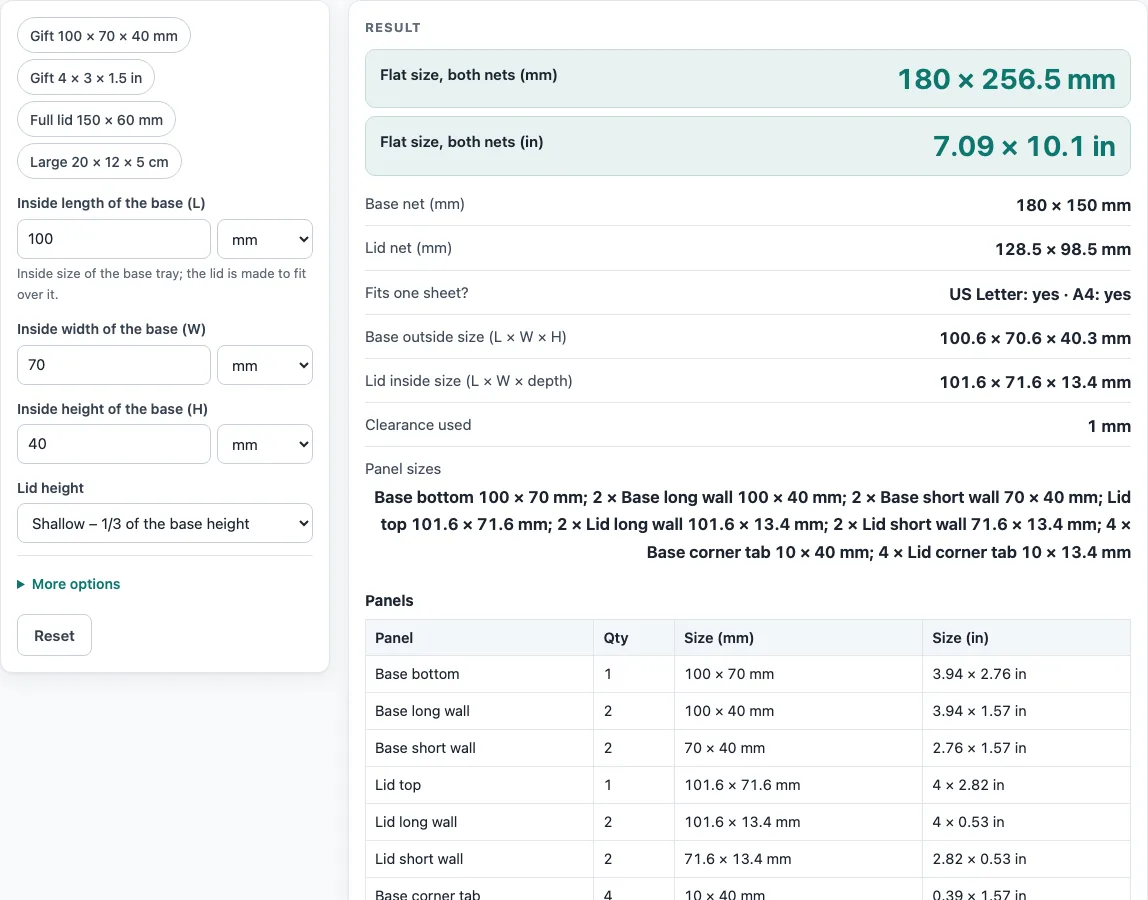
- Type your sizes into Inside length of the base (L), Inside width of the base (W) and Inside height of the base (H). Each field has a unit menu: mm, cm or in.
- Set a Lid height. Shallow (1/3 of the base height) is selected by default, with Half of the base height and Full (as tall as the base) as the other choices.
- Open More options to adjust Lid clearance, Corner tab width or Material thickness. If Lid clearance is left empty, an automatic value is applied. Clearance and thickness accept mm or in.
- Review the outputs: Flat size, both nets, Base net (mm), Lid net (mm), Fits one sheet?, Base outside size, Lid inside size, Clearance used and Panel sizes. Note any warning that shows up.
- Inspect the drawing. Solid lines mark cuts, dashed lines mark folds, and grey areas are where glue goes.
- Click Download SVG (true size) for printing and design software, or Download DXF (CAD / cutter) for CAD programs, plotters and cutting machines.
- For printing, select Print / save as PDF and set the printer to 100 %, not “fit to page”.
Sample sizes load from the example buttons: Gift 100 × 70 × 40 mm, Gift 4 × 3 × 1.5 in, Full lid 150 × 60 mm and Large 20 × 12 × 5 cm. Pressing Copy link stores every input in the page address, and Reset brings back the defaults.
How do you make a gift box with a lid?
A box with a lid is two trays, each cut from one flat net and folded up. Each net is a bottom panel with four walls folded up from its edges. A glue tab sits on each side of the two short walls, and folds in to be glued to the inside of the long walls. The lid’s inside size is the base’s outside size plus a small clearance, so the lid slides over the base.
The tool works through these steps using your numbers. The base outside size is the inside size plus twice the thickness t in length and width, plus one t in height. Next, the lid inside size equals the base outside size plus the clearance. Its depth is the base outside height times the lid fraction you chose. Each net is the bottom plus two wall heights in each direction.
With the default 100 × 70 × 40 mm and 0.3 mm thickness, the base outside size comes to 100.6 × 70.6 × 40.3 mm. Using the automatic 1 mm clearance, the lid inside size is 101.6 × 71.6 mm, and its depth is 13.4 mm. The base net measures 180 × 150 mm and the lid net 128.5 × 98.5 mm. Side by side they would not fit one sheet, so the tool stacks them with an 8 mm gap, giving 180 × 256.5 mm, which fits US Letter and A4.
How does material thickness change the template?
Thickness changes the outside size of the base, so the lid changes too. The base net itself is drawn at the inside size you enter. Built from the base’s outside size, the lid gains twice t in length and width and one t in height.
Clearance is the extra inside size of the lid, counted over length and width together. Leave it empty and the tool uses 1 mm, or twice the thickness if that is larger. A clearance smaller than the thickness makes the lid hard to put on, and the tool warns about it. Also, the tool warns when the lid is under 12 mm deep, because it can slip off.
Sources
- Panel sizes, flaps and curves are plain geometry (no packaging standard is copied); FEFCO style codes are used only as names
- Paper sizes: A4 210 × 297 mm and A3 297 × 420 mm (ISO 216), US Letter 8.5 × 11 in and Tabloid 11 × 17 in (ANSI/ASME Y14.1)
- 1 in = 25.4 mm exactly (NIST SP 811)
Worked examples
| Input | Result |
|---|---|
| 100 × 70 × 40 mm | Flat 180 × 256.5 mm; US Letter: yes · A4: yes |
| 4 × 3 × 1.5 in | Flat 177.8 × 263.8 mm; US Letter: yes · A4: yes |
| 150 × 150 × 60 mm | Flat 554 × 276 mm; US Letter: no · A4: no |
| 20 × 12 × 5 cm | Flat 559.9 × 220 mm; US Letter: no · A4: no |
Calculated by the tool above with these values.
Frequently asked questions
Is the calculator free, and is anything I type uploaded?
Yes, the tool is free and runs entirely in your browser. It needs no sign-up, and nothing you type is uploaded.
Can I use the results in commercial work such as quotes and bids?
Yes. Templates and results may be used in commercial work, including boxes that are sold and files sent to printers and die makers, and no attribution is needed. Make a sample before a production run, because board thickness, grain direction and your printer or cutter change the fit.
Why does my template not fit on one sheet?
If the base or lid net is larger than one US Letter or A4 sheet, print it tiled, print it on A3 or Tabloid, or use the SVG or DXF file. If both nets together do not fit but each one does on its own, print the base and the lid on two separate sheets.
What lid height should I choose?
The default is a shallow lid, one third of the base’s outside height. A full lid covers the whole base. If the lid is under 12 mm deep the tool warns that it may slip off easily, so choose a half or full lid in that case.
Can it make a heart box or an exploding box template?
No. This tool draws a rectangular base and lid only. It has no heart-shaped or exploding-box layout.
Related tools
- Rectangle box template: choose this for a plain rectangular box with simple folds.
- Gable box template: pick it if you want a peaked, house-style top.
- Pillow box template: makes a soft, pillow-shaped box with sealed ends.
- Paper bag template: a better fit than a rigid box when your gift calls for a bag.
- Box template generator: generates other box shapes that no dedicated template covers.
- Tuck box template: a single-piece box that closes with a tuck flap.
- Pizza box dieline: suited to a larger takeaway-style box, with a dieline ready for print production.
- Matchbox template: builds a small box that slides open like a drawer.
- All calculators: lists every calculator on the site for browsing.