Hexagon Box Template
Enter the hexagon side or the width across flats and the height, and get the net of a hexagonal box with a separate lid or a tuck top.
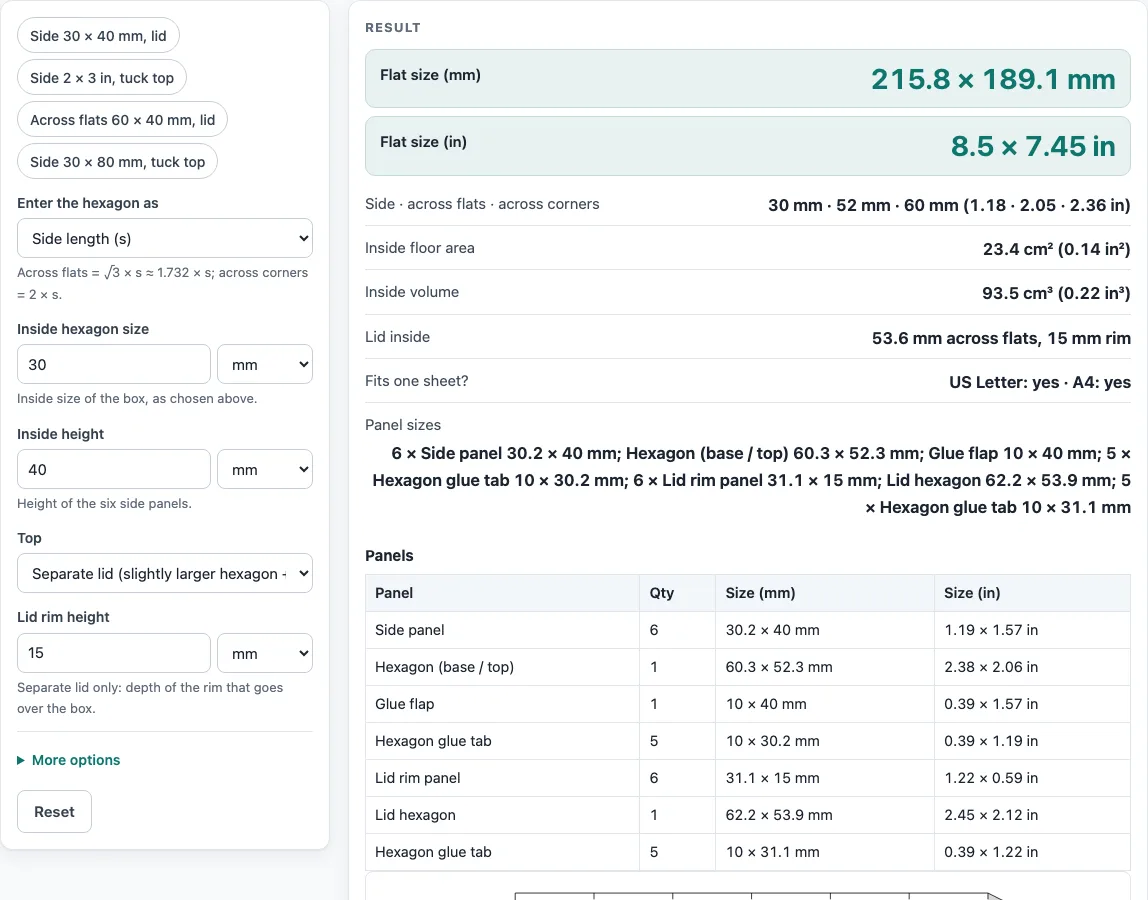
How to use the hexagon box template
- In ‘Enter the hexagon as’, pick either ‘Side length (s)’ or ‘Width across flats (√3 × s)’.
- Enter the ‘Inside hexagon size’. Depending on step 1, it counts as a side length or a width across flats.
- Fill in the ‘Inside height’.
- Under ‘Top’, select ‘Separate lid (slightly larger hexagon + rim)’ or ‘Tuck-flap top (hexagon hinged to one side)’.
- With a separate lid, adjust the ‘Lid rim height’ (default 15 mm).
- If you want, expand ‘More options’ to alter ‘Lid clearance’ (default 1 mm), ‘Glue tab width’ (default 10 mm) or ‘Material thickness’ (default 0.3 mm).
- Check the outputs: ‘Flat size (mm)’, ‘Flat size (in)’, ‘Side · across flats · across corners’, ‘Inside floor area’, ‘Inside volume’, ‘Lid inside’ (separate lid only), ‘Fits one sheet?’ and ‘Panel sizes’.
- Click ‘Download SVG (true size)’ or ‘Download DXF (CAD / cutter)’, or choose ‘Print / save as PDF’ and print at 100%, not fit to page.
Sample sizes appear when you press the example buttons. On the printed net, solid lines get cut, dashed lines get folded and grey areas receive glue. Before cutting, measure one printed edge against the size shown. ‘Copy link’ keeps all your inputs, ‘Copy result’ copies the figures, ‘How it was calculated’ shows each step, and ‘Reset’ clears the form. Entering a material thickness above 3 mm sets off a warning.
What is the formula for the width across flats of a hexagon?
For a regular hexagon with side s, the width across flats is √3 × s, about 1.732 × s. Across corners, the width is 2 × s, so across flats is always the shorter one. For a side of 40 mm, the width across flats is 69.3 mm and across corners is 80 mm.
How do I calculate the side length of a hexagon box from its width?
Divide the width across flats by √3: s = across flats ÷ √3. A hexagon 60 mm across flats has a side of 34.6 mm and is 69.3 mm across corners. If you measured the opening from flat side to flat side, choose ‘Width across flats (√3 × s)’. If you know the side, choose ‘Side length (s)’.
How do I make a hexagon box template with a lid?
Set ‘Top’ to the separate lid. The net is a strip of six side panels, each as high as the box, with a glue flap at one end. A hexagon base hangs from the first panel and has five glue tabs on its other edges. The lid is built the same way, with a hexagon top and a rim of six panels.
Measurement runs along the middle of the sheet, so each panel side is p = s + t ÷ √3, where t is the material thickness. Inside across flats for the lid equals the box’s outside across flats plus the lid clearance. For s = 40 mm and t = 0.3 mm that is 69.28 + 0.6 + 1 = 70.88 mm.
How do I make a hexagonal gift box with a tuck top?
Set ‘Top’ to the tuck-flap top. The top hexagon hangs from the first side panel and carries a tuck flap on its opposite edge. The flap length is the smaller of height ÷ 2 and 0.6 × p, and its width is p − 2 × (t + 0.5 mm). Fold the top closed and tuck the flap inside the side opposite the hinge. With s = 40 mm, a height of 50 mm and no thickness, the flat net is 273.7 × 222.6 mm.
Sources
- Regular hexagon: across flats = √3 × side, across corners = 2 × side, apothem = (√3 / 2) × side, area = (3√3 / 2) × side², perimeter = 6 × side — Wikipedia, Hexagon (regular hexagon section)
- Panel widths with material thickness, glue tabs, lid clearance and tuck flap sizes are plain geometry with our own design parameters (shown in the steps)
- Paper sizes: A4 210 × 297 mm and A3 297 × 420 mm (ISO 216), US Letter 8.5 × 11 in and Tabloid 11 × 17 in (ANSI/ASME Y14.1)
- 1 in = 25.4 mm exactly (NIST SP 811)
Worked examples
| Input | Result |
|---|---|
| 30 mm (side) × 40 mm, separate lid | Flat 215.8 × 189.1 mm; US Letter: yes · A4: yes |
| 2 in (side) × 3 in, tuck top | Flat 345.2 × 293.5 mm; US Letter: no · A4: no |
| 60 mm (across flats) × 40 mm, separate lid | Flat 246 × 202.2 mm; US Letter: yes · A4: no |
| 30 mm (side) × 80 mm, tuck top | Flat 210.5 × 213.1 mm; US Letter: no · A4: no |
Calculated by the tool above with these values.
Frequently asked questions
How do I make a printable hexagon box template PDF?
Enter your sizes, check the results and press ‘Print / save as PDF’. Print at 100%, not fit to page. ‘Fits one sheet?’ tests US Letter and A4 with a 1/4 in margin. If the net is too big, print it tiled across sheets or on A3 or Tabloid, or send the SVG or DXF file to a plotter or cutter.
How big should the lid of a hexagon box be?
Set the ‘Lid clearance’ in ‘More options’; the default is 1 mm, and the result ‘Lid inside’ shows the lid’s inside across flats and rim height. A rim under 12 mm gets a shallow-rim warning, and a clearance under 0.5 mm gets a very-tight warning.
Can I use it as a wood hexagon box template?
The net is a fold-up layout, so it suits paper, cardstock and thin board. It does not model wood joints. For a wood box, use the side, across-flats and height figures as starting dimensions and design the joints yourself.
Can I use the hexagon box template for commercial purposes or sell boxes on Etsy or Amazon KDP?
Yes. Templates you print or download may be used commercially, including for boxes sold on Etsy or Amazon KDP, royalty-free and with no attribution. The only limit is that you may not rebuild this generator as a competing service.
Is the calculator free, and is anything I type uploaded?
Yes, it is free, runs in your browser and needs no sign-up. Nothing you type is uploaded.
Related tools
- Box template generator: good for general box nets when the box is not hexagonal.
- Gift box template: suited to a rectangular gift box with a separate lid.
- Pyramid template: the pick for pyramid-shaped nets with a single apex.
- Cube template: covers six-square cube nets.
- Tuck box template: made for folding cartons with a tuck-in top.
- Pillow box template: fits pillow-shaped boxes with sealed ends.
- Gable box template: a match for boxes with a pitched roof-style lid.
- Cylinder template: built for round tubes and cylindrical containers.