Matchbox Template
Enter the inside size of the drawer, the slide clearance and the paper thickness, and get the drawer and sleeve templates to print or download.
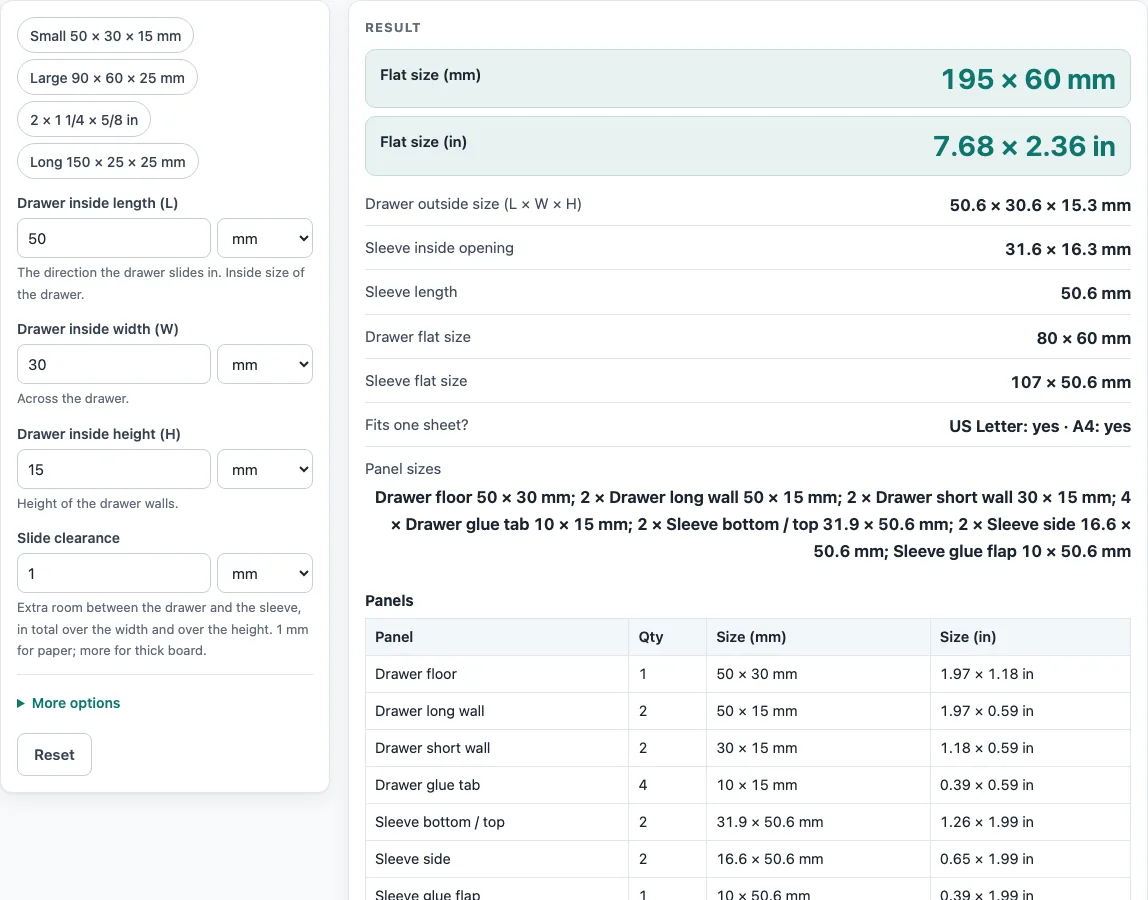
How to use the matchbox template
Enter the inside size of the drawer, not the outside size of the box.
- Type the ‘Drawer inside length (L)’, the direction the drawer slides.
- Type the ‘Drawer inside width (W)’ and ‘Drawer inside height (H)’. Each value has its own unit.
- Check ‘Slide clearance’. The default is 1 mm, and you can switch the unit between mm and in.
- Open ‘More options’ to change the ‘Glue flap width’ (default 10 mm) and ‘Material thickness’ (default 0.3 mm). The hint suggests 0.2 mm for paper, 0.3 mm for cardstock and 0.5 to 1 mm for chipboard.
- Or press an example button: ‘Small 50 × 30 × 15 mm’, ‘Large 90 × 60 × 25 mm’, ‘2 × 1 1/4 × 5/8 in’ or ‘Long 150 × 25 × 25 mm’. These are example sizes only.
- Read ‘Flat size (mm)’, ‘Drawer outside size (L × W × H)’, ‘Sleeve inside opening’, ‘Sleeve length’ and ‘Fits one sheet?’, and any warning.
- Press ‘Download SVG (true size)’ or ‘Download DXF (CAD / cutter)’ if you cut with a machine.
- Press ‘Print / save as PDF’ and print at 100%, not fit to page.
On the printed net, solid lines are cut, dashed lines are folded and grey areas take glue. Measure one printed edge against the size shown before you cut.
‘Copy link’ keeps every input in one link, ‘Copy result’ copies the figures, and ‘Reset’ clears the form. ‘How it was calculated’ shows each step with your numbers.
How do I make a matchbox template with measurements?
Begin by measuring the drawer’s inside size. Adding the material thickness gives the outside size, and the sleeve is built around that size plus the slide clearance.
Call the inside length, width and height L, W and H, with t for material thickness and c for slide clearance:
- Drawer outside size = (L + 2t) × (W + 2t) × (H + t). Each of length and width picks up a thickness on both sides, while height picks up one for the floor.
- Sleeve inside opening = (W + 2t + c) × (H + t + c).
- Sleeve length = L + 2t.
- Every panel gets its inside size plus t: bottom and top run (W + 2t + c) + t wide, sides run (H + t + c) + t wide, and the strip also holds the glue flap.
Using the defaults (50 × 30 × 15 mm, t = 0.3 mm, c = 1 mm, glue flap 10 mm), the drawer’s outside size comes to 50.6 × 30.6 × 15.3 mm. The sleeve opening reads 31.6 × 16.3 mm, and the panels measure 31.9 mm and 16.6 mm wide. Strip width is 107 mm (97 mm for four panels plus the 10 mm flap) with a 50.6 mm length. The drawer net is 80 × 60 mm, and placing both nets side by side gives 195 × 60 mm.
What size should the sleeve of a matchbox be compared with the drawer?
Opening comes from the drawer’s outside cross-section plus slide clearance, spread across width and height. Length matches the drawer’s outside length so the ends line up.
Fit depends mostly on clearance. The tool warns below 0.5 mm that the drawer will probably stick, and above 4 mm that it will rattle, and it suggests 1 to 2 mm. Set both thickness and clearance to zero and a 50 × 30 × 15 mm drawer yields a 30 × 15 mm opening, which triggers a very-tight clearance warning on this page. Our tool sets the glue flap width and 1 mm clearance itself; neither comes from a standard, and the example sizes aren’t standard matchbox dimensions.
Sources
- Layouts for drawer and sleeve, plus the clearance and glue-flap defaults, follow plain geometry using our own design parameters (shown in the steps); the presets are example sizes, not standard matchbox sizes
- Thickness convention: the drawer follows the tray net of the gift box template (outside = inside + 2t; height + t), and each sleeve panel is its inside size + t, as in the tuck box layout
- Paper sizes: A4 210 × 297 mm and A3 297 × 420 mm (ISO 216), US Letter 8.5 × 11 in and Tabloid 11 × 17 in (ANSI/ASME Y14.1)
- 1 in = 25.4 mm exactly (NIST SP 811)
Worked examples
| Input | Result |
|---|---|
| 50 × 30 × 15 mm | Flat 195 × 60 mm; US Letter: yes · A4: yes |
| 2 × 1.25 × 0.6 in | Flat 200.5 × 62.2 mm; US Letter: yes · A4: yes |
| 90 × 60 × 25 mm | Flat 189 × 209 mm; US Letter: yes · A4: yes |
| 7 × 4 × 2 cm | Flat 257 × 80 mm; US Letter: yes · A4: yes |
Calculated by the tool above with these values.
Frequently asked questions
How do I make a DIY matchbox out of paper?
Enter your drawer size and set ‘Material thickness’ to about 0.2 mm for paper, then print at 100% on Letter or A4. Glue the drawer tabs inside the long walls, wrap the sleeve around the drawer, glue the flap under the first panel and slide the drawer in.
Is there a free printable matchbox template?
Yes. This template is free, and you can print the flat net with ‘Print / save as PDF’ at 100% scale. Check ‘Fits one sheet?’ for Letter or A4. If the two parts do not fit together, the tool tells you when each fits a sheet on its own. Otherwise print tiled, or send the SVG or DXF file to a plotter or cutter.
How much clearance does a sliding matchbox drawer need?
The default is 1 mm. Below 0.5 mm the drawer will probably stick, and above 4 mm it will rattle. Test a sample in your material before you make many.
How do I size a matchbox for a gift?
Measure the item, leave a little room for it inside the drawer, and enter that as the drawer inside size. Start from your own measurements, because the example buttons are not standard sizes. For board over 3 mm thick, the tool recommends a creasing rule and a test sample.
Can I sell boxes made from a printed matchbox template?
Yes. Templates you print or download may be used commercially, including for boxes sold on Etsy or Amazon KDP, royalty-free and with no attribution. The only limit is that you may not rebuild this generator as a competing service.
Is the calculator free, and is anything I type uploaded?
Yes, it is free, runs in your browser and needs no sign-up. Nothing you type is uploaded.
Related tools
- Gift box template: pick this for a lidded box when you need a separate top instead of a sliding drawer.
- Tuck box template: a folding carton that closes with a tuck flap is what this one makes.
- Box template generator: compare several box styles side by side here when you are still choosing.
- Rectangle box template: open-top rectangular boxes come out of this simple layout.
- Pillow box template: built for a pillow-shaped gift box.
- Gable box template: a peaked lid is the feature this one gives you.
- Card box template: sized to hold a card, this small box fits the job.
- Cube template: equal sides make a closed cube, which this one produces.