Pillow Box Template
Enter the pillow box's length, width and depth to get a printable template with curved fold lines.
The pillow box template calculator gives you a printable, cuttable net for a pillow box: a tube glued along one edge whose two ends are pressed flat along curves, so the box bulges in the middle. Enter the length, flat width and depth, and the tool draws the net at true size, shows the flat size in millimeters and inches, and says whether it fits one US Letter or A4 sheet. It is free, runs in your browser, needs no sign-up, and uploads nothing you type.
Download the net as an SVG or DXF file, or print it at actual size. It suits a favor box, a candy box or a gift card pillow box. The end-curve geometry is this tool’s own convention, so a test print is recommended.
How to use the Pillow Box Template Calculator
- Pick a unit for each length from its menu: mm, cm or in. Material thickness offers mm or in. To start quickly, press an example: Gift 100 × 60 × 25 mm, Large 150 × 80 × 35 mm, Favor 4 × 2.5 × 1 in or Candy 12 × 6 × 2.5 cm.
- Enter Length (L), the finished length of the box, measured along the straight side edge between the two end fold curves.
- Enter Flat width (w), the width of one panel, front or back, lying flat.
- Enter Depth (D), the thickness of the filled box at its middle. It sets the curve of the ends. The tool stops with an error if the depth is larger than the panel width.
- Open More options to change Glue flap width (10 mm by default) and Material thickness (0.3 mm by default).
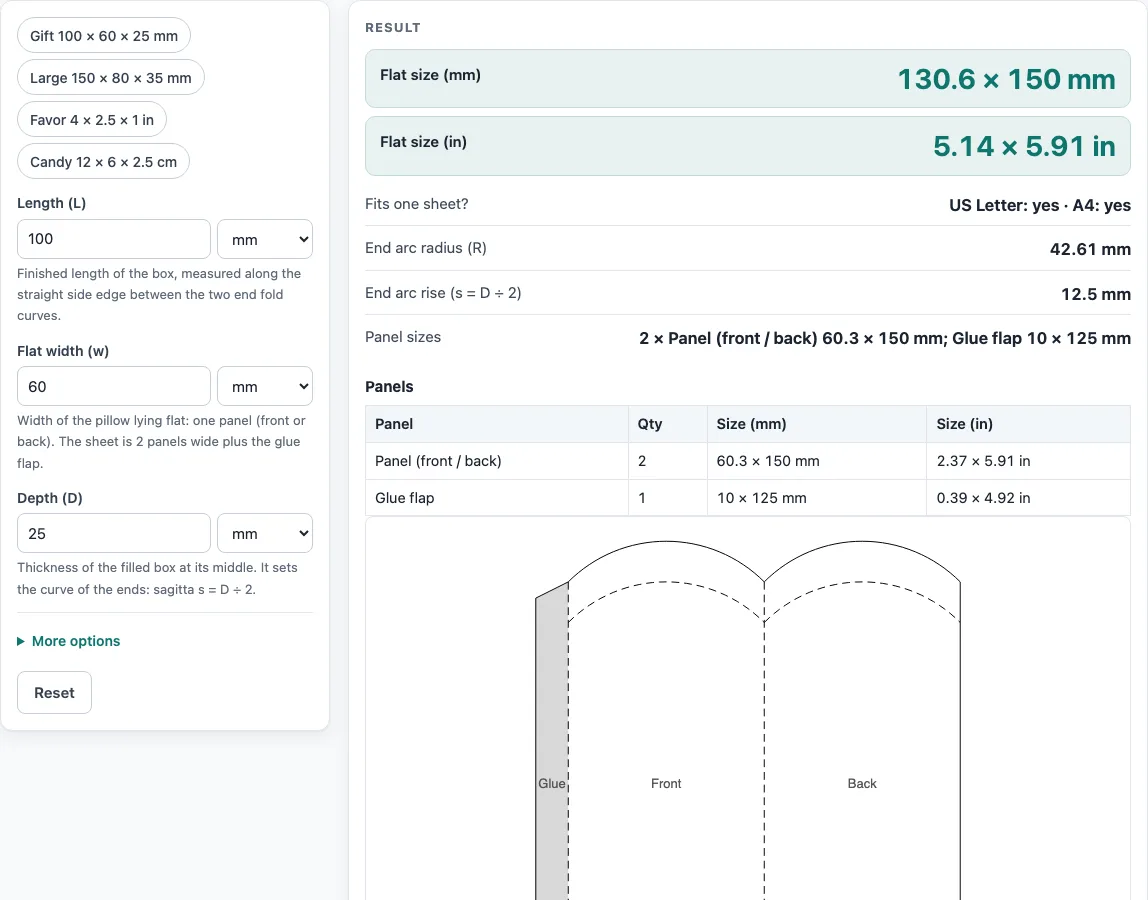
- Read Flat size (mm), Flat size (in), Fits one sheet?, End arc radius (R), End arc rise (s = D ÷ 2) and Panel sizes. Read any warning before you go on.
- Check the drawn template, then choose Download SVG (true size), Download DXF (CAD / cutter) or Print / save as PDF.
Solid lines are cut lines, dashed lines are folds, and grey areas take glue. Copy result copies the result lines, Copy link copies an address that holds every input, and Reset restores the defaults.
How do you make a pillow box?
Cut a flat sheet that has two panels side by side and a glue flap at one edge. Crease the dashed lines, glue the flap inside the last panel to close the tube, then press each end in along its curve so the ends fold flat and the box bulges in the middle.
How is the flat size of a pillow box worked out?
The tool uses a few steps, shown here with the default values of 100 × 60 × 25 mm:
- Panel width: c = w + t = 60 + 0.3 = 60.3 mm, where t is the material thickness.
- Arc rise: s = D ÷ 2 = 12.5 mm. Each end flap must travel half the depth to meet its partner when the tube is pressed flat.
- Arc radius: R = (c² ÷ 4 + s²) ÷ (2s) = 42.6 mm. This is the circle through the two panel corners that bulges outward by s.
- Sheet height: L + 4s = 100 + 50 = 150 mm. Each end has the cut arc rise s plus a fold curve offset of the same size.
- Sheet width: glue flap + 2 panels = 10 + 2 × 60.3 = 130.6 mm.
The thickness term is there because each panel wraps round two folds of the tube, so the tool adds t once to each panel width. This arc construction is the tool’s own convention, not a published standard, so a test print is recommended.
What do depth and length do to the shape?
Depth controls the curve of the ends, so a larger depth gives a rounder pillow. The tool warns when the depth is under 10 % of the panel width, because the ends are almost straight and the box looks like an envelope. It warns above 80 % of the panel width, because the pillow is very round, the ends are hard to close and the sheet gets tall.
It also warns when the length is under twice the depth, because the two end curves almost meet. Check those sizes with a printed test before you cut the final run.
Sources
- Panel sizes, flaps and curves are plain geometry (no packaging standard is copied); FEFCO style codes are used only as names; end curves from the chord–sagitta formula of a circular segment
- Paper sizes: A4 210 × 297 mm and A3 297 × 420 mm (ISO 216), US Letter 8.5 × 11 in and Tabloid 11 × 17 in (ANSI/ASME Y14.1)
- 1 in = 25.4 mm exactly (NIST SP 811)
Worked examples
| Input | Result |
|---|---|
| 100 × 60 × 25 mm | Flat 130.6 × 150 mm; US Letter: yes · A4: yes |
| 4 × 2.5 × 1 in | Flat 137.8 × 152.4 mm; US Letter: yes · A4: yes |
| 150 × 80 × 35 mm | Flat 170.8 × 220 mm; US Letter: yes · A4: yes |
| 12 × 6 × 2.5 cm | Flat 130.6 × 170 mm; US Letter: yes · A4: yes |
Calculated by the tool above with these values.
Frequently asked questions
Is the calculator free, and is anything I type uploaded?
Yes, it is free, needs no sign-up, and runs entirely in your browser. Nothing you type is uploaded.
Can I use the results in commercial work such as quotes and bids?
Yes. Templates and results may be used in commercial work, including boxes and bags that are sold and files sent to printers and die makers. No attribution is needed, but make a sample before a production run.
Why does the result say my net does not fit one sheet?
The flat net is larger than one US Letter or A4 sheet with a 1/4 in margin. Print it tiled or on A3 or Tabloid, or send the SVG or DXF file to a plotter or cutter.
What material thickness should I enter?
The tool’s hint lists 0.2 mm for paper, 0.3 mm for cardstock, and 0.5–1 mm for chipboard. For thickness over 3 mm the tool warns that panels will not fold at a sharp fold line, so use the DXF with a creasing rule and test a sample first.
Can I cut a pillow box template with a Cricut?
Download the SVG or DXF file and load it into your cutting software. Cut the solid lines, and use a scoring or creasing tool on the dashed lines if your machine supports it. Test one box before you cut a full batch.
Related tools
- Rectangle box template: use it for a box with straight sides and no curved ends.
- Gift box template: use it when you want a general gift box rather than a pillow shape.
- Gable box template: use it for a box with a peaked lid.
- Paper bag template: use it when you need a bag rather than a closed box.
- Box template generator: use it to make a template for a box type that is not covered by a specific page.
- Pizza box dieline: use it for a large, shallow food box.
- Tuck box template: use it for a folding carton with a tuck-in flap.
- All calculators: use it to browse every calculator on the site.