Pizza Box Dieline Generator
Enter the pizza box's inside size and the board flute to get a dieline with fold lines and the flat blank size.
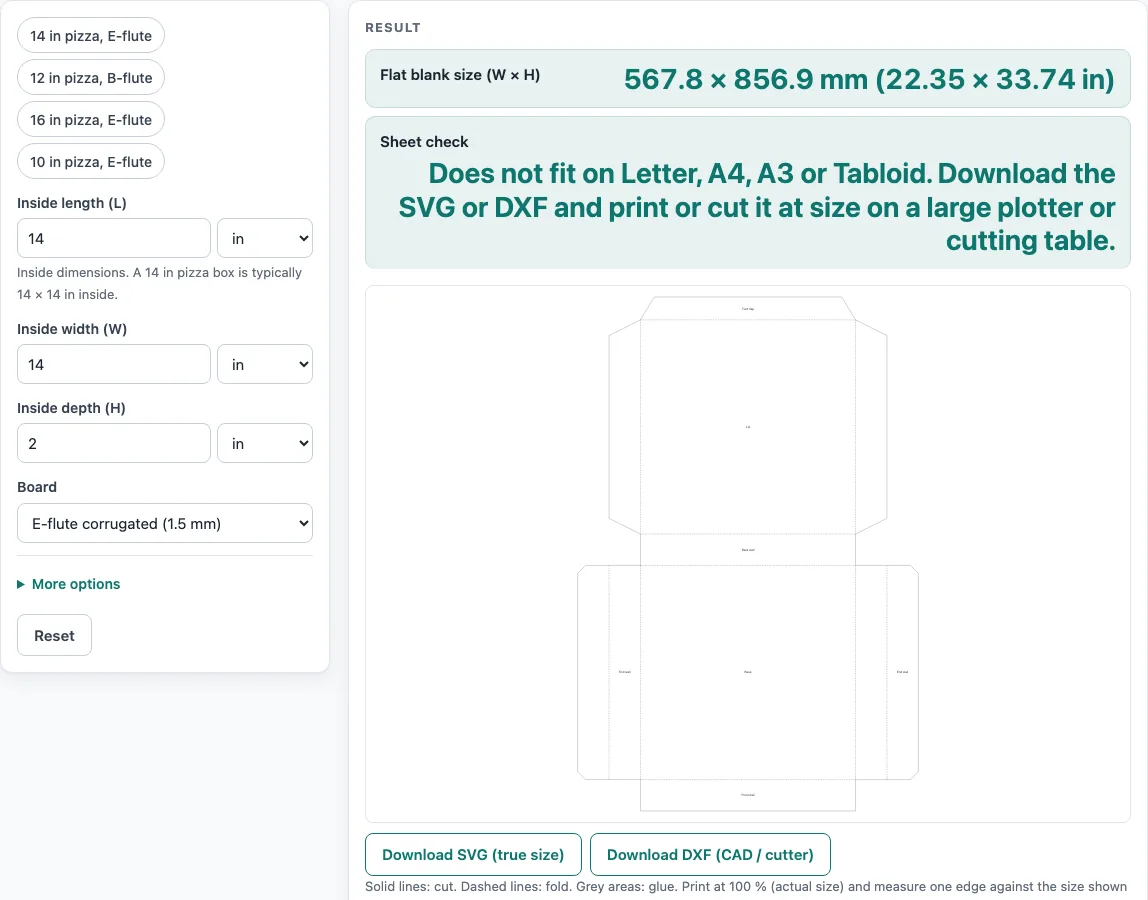
How to use the pizza box dieline tool
- Set the unit for each measurement using its menu: inches, millimeters or centimeters.
- Enter the Inside length (L), Inside width (W) and Inside depth (H). For a 14 in pizza box, enter 14, 14 and 2, which are the defaults.
- Choose the Board: E-flute corrugated (1.5 mm), B-flute corrugated (3 mm) or Custom thickness. If you pick Custom thickness, enter the Board thickness (T) and set its unit.
- Open More options if you need to change the Tuck-flap depth, the flap on the lid that tucks into the front wall. The default is 1.5 in.
- Read the Flat blank size (W × H) and the Sheet check in the result. A warning appears if the tuck flap is deeper than the front wall, or if the blank is larger than a 4 × 8 ft sheet of board.
- Look at the template. Solid lines are cuts, dashed lines are folds, and grey areas take glue.
- Open How it was calculated to see each step with your own numbers. The tables show the panel sizes and the blank for common pizza box sizes.
- Download the SVG (true size) or DXF (CAD / cutter) file, or choose Print / save as PDF and print at 100 %.
To start faster, use an example button above the form: 14 in pizza (E-flute), 12 in pizza (B-flute), 16 in pizza (E-flute) or 10 in pizza (E-flute). Copy result copies the result lines, and Copy link copies a page address that holds every input, so the same template reopens later. Reset restores the defaults.
What is a pizza box dieline?
A dieline is the flat plan of a box. It shows the cut lines, fold lines and glue areas that turn one sheet of board into a finished box. For a pizza box, this plan is a single flat piece called a blank. The tool draws the blank for a roll-end tuck-front box, a one-piece folding box with double end walls that roll over and a front tuck flap. This is a common style for pizza and mailer boxes. The name FEFCO 0427 is used here only to name the style; the drawing is the tool’s own geometry.
What size is a pizza box?
Pizza boxes are usually named by their inside square size in inches, so a 12 in box is 12 × 12 in inside. The depth varies. About 1.75 to 2 in is common, but there is no standard depth. Because the tool works from the numbers you enter, set the inside length, width and depth you need instead of relying on the name alone.
The tool also shows a table of six common sizes, from 8 × 8 × 1.75 in to 18 × 18 × 2 in. It uses the board and tuck-flap depth you have set. With the defaults (E-flute, 1.5 in tuck), the 8 in row is a 390 × 539.4 mm blank and the 18 in row is 669.4 × 1060.1 mm. These are common sizes, not a standard.
How is the blank size worked out?
The tool adds the board thickness (T) to every panel that wraps around the box. Each end wall is a double layer because it rolls, so the base is L + 2T long. Here is the default example, 14 × 14 × 2 in with E-flute (T = 1.5 mm):
- Inside size: 355.6 mm × 355.6 mm × 50.8 mm.
- Base length: L + 2T = 358.6 mm. Base width: W + T = 357.1 mm.
- Wall height: H + T = 52.3 mm.
- Blank width: 358.6 + 4 × 52.3 = 567.8 mm.
- Blank height: tuck + lid + back wall + base + front wall = 38.1 + 357.1 + 52.3 + 357.1 + 52.3 = 856.9 mm.
The result is 567.8 × 856.9 mm, or 22.35 × 33.74 in. Thicker board needs more allowance at the folds: with B-flute (3 mm) the same box becomes 576.8 × 862.9 mm. Nominal thicknesses are about 1.5 mm for E flute, 3 mm for B flute and roughly 4 mm for C flute. For C flute, choose Custom thickness and enter about 4 mm, or the caliper your supplier gives you.
Sources
- Packlane, How thick is the material of my boxes and Sourceful, corrugated flutes — E-flute about 1/16 in (1.5 mm), B-flute about 1/8 in (3 mm)
- Stock pizza box sizes from US foodservice distributors, e.g. Boelter (8 × 8 × 1.75, 16 × 16 × 2 in) and WebstaurantStore (18 × 18 × 2 in)
- Panel sizes, flaps and curves are plain geometry (no packaging standard is copied); FEFCO style codes are used only as names
- 1 in = 25.4 mm exactly (NIST SP 811)
Worked examples
| Input | Result |
|---|---|
| 14 × 14 × 2 in, E-flute corrugated (1.5 mm) | Blank 567.8 × 856.9 mm (22.35 × 33.74 in) |
| 12 × 12 × 1.75 in, B-flute corrugated (3 mm) | Blank 500.6 × 748.6 mm (19.71 × 29.47 in) |
| 355 × 355 × 45 mm, E-flute corrugated (1.5 mm) | Blank 544 × 841 mm (21.42 × 33.11 in) |
| 18 × 18 × 2 in, B-flute corrugated (3 mm) | Blank 678.4 × 1078.8 mm (26.71 × 42.47 in) |
Calculated by the tool above with these values.
Frequently asked questions
Is the calculator free, and is anything I type uploaded?
Yes, the tool is free and needs no sign-up. It runs entirely in your browser, and nothing you type is uploaded.
Can I use the results in commercial work such as quotes and bids?
Yes. Templates and results may be used in commercial work, including boxes and bags that are sold and files sent to printers and die makers. No attribution is needed.
Why does the blank not fit on my home printer?
The Sheet check shows when a blank is too large for Letter, A4, A3 or Tabloid paper. Download the SVG or DXF file and print or cut it at size on a large plotter or cutting table. If you print the PDF, set the printer to 100 %, not “fit to page.”
Are the common pizza box sizes in the table a standard?
No. The table lists sizes that are commonly used, 8 to 18 in square and 1.75 to 2 in deep. It follows the board and tuck-flap depth you set, so the blank sizes change when you change them.
Which board should I choose?
E-flute (1.5 mm) is the default and B-flute (3 mm) is thicker. Both are nominal values, so use Custom thickness with your supplier’s measured caliper if you know it.
Should I make a sample before a production run?
Yes. The template is a starting point. Board thickness, grain direction, your printer and your cutter all change the fit, so make a test sample before ordering a full run.
Related tools
- Box template generator: use this when you need a box shape other than a pizza box.
- Tuck box template: use this for a tuck-style box with a different layout.
- Rectangle box template: use this for a plain rectangular box.
- Paper bag template: use this when you need a bag rather than a box.
- All calculators: browse every calculator on the site.